
VoIP Failover & Redundancy: More Reliable Than Traditional Phone Lines
When Hurricane Ian knocked out AT&T and Comcast lines for 1-2 weeks across Florida, Mynians VoIP clients maintained 99.9% uptime. Modern VoIP redundancy Florida systems aren’t just backup plans—they’re the primary reliability strategy that makes traditional phone lines obsolete.
- 4-Layer Redundancy: Geographic, internet, device, and multi-location failover
- Automatic Failover: Under 30 seconds to backup systems—customers never hear silence
- Mobile Continuity: Calls route to smartphones when offices lose power or connectivity
- Geographic Diversity: Jacksonville and Tampa data centers with 12ms latency
- Hurricane-Proven: 99.9% uptime during Hurricane Ian (September 2022)
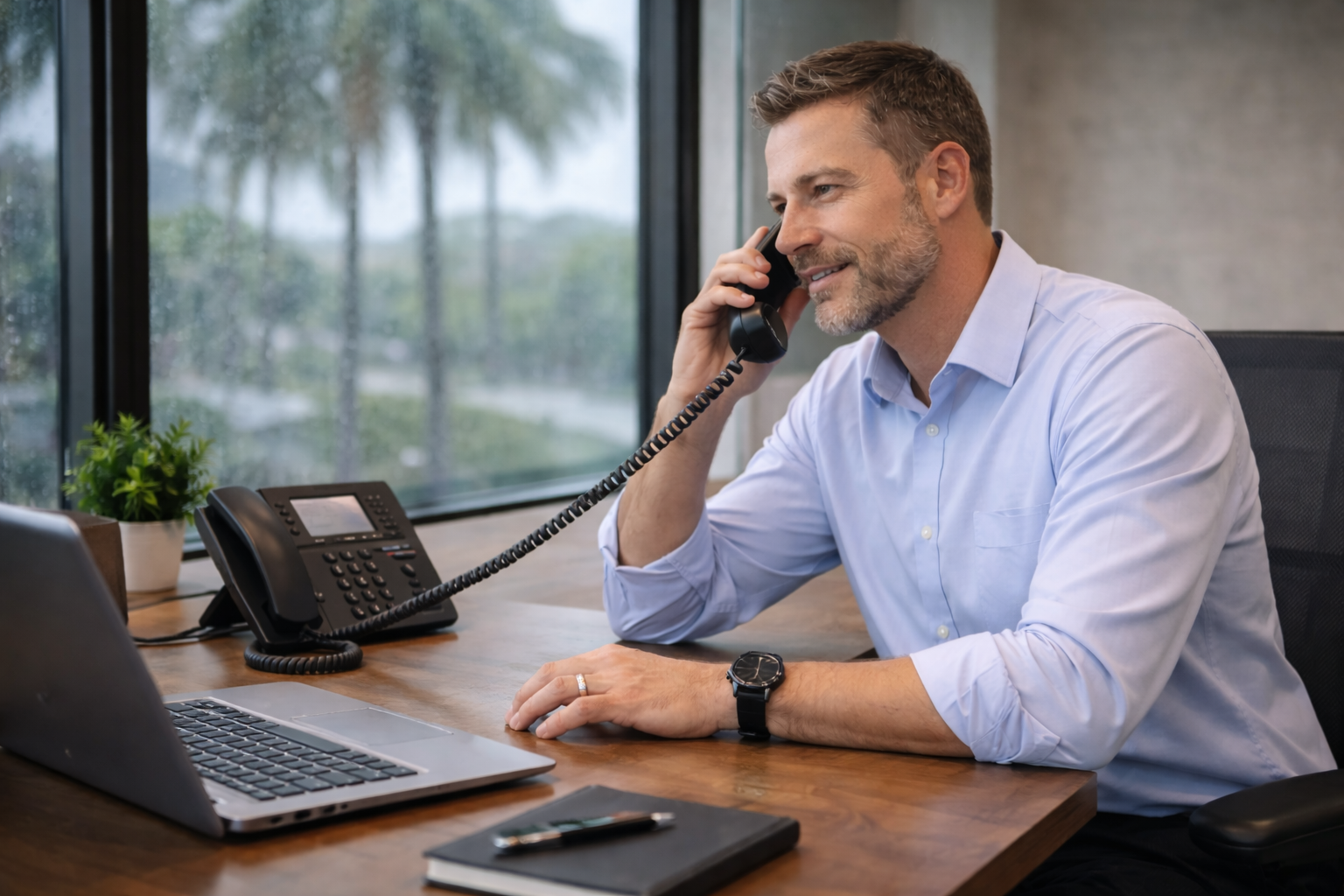
The question “What happens if my internet goes down?” is the most common VoIP objection we hear from Florida business owners. It’s a smart question—but the answer reveals why VoIP is actually MORE reliable than traditional phone lines, not less.
Traditional phone systems have a single point of failure: the physical copper line to your building. When Hurricane Ian damaged AT&T infrastructure across Southwest Florida in September 2022, businesses lost phone service for 1-2 weeks. No backup. No failover. Just silence.
Modern VoIP redundancy Florida systems build reliability through multiple independent layers. When one fails, the others automatically take over. The result? Our Orlando business clients experienced zero customer-facing downtime during the worst hurricane to hit Florida in decades.
This page explains exactly how VoIP disaster recovery works, why it’s superior to traditional telephony, and how to configure your system for maximum business continuity Florida during hurricanes, power outages, internet failures, and other disruptions.
The 4 Layers of VoIP Redundancy
Enterprise-grade reliability through independent, automatic failover systems
Layer 1: Geographic Redundancy
Multiple data centers across Florida eliminate regional failures
Mynians operates VoIP infrastructure in two geographically diverse Florida locations: Jacksonville (Northeast) and Tampa (Southwest). Your phone system runs simultaneously in both data centers with real-time synchronization.
How it works: If Hurricane Ian damages the Tampa data center (as happened in September 2022), your VoIP service automatically fails over to Jacksonville within milliseconds. Customers calling your business number experience zero downtime—the call simply routes through the unaffected infrastructure.
Why this matters: Traditional phone carriers (AT&T, Comcast Business, Spectrum Business) rely on regional physical infrastructure. When Hurricane Ian’s 150 mph winds toppled cell towers and severed fiber lines across Southwest Florida, their customers lost service for 1-2 weeks. Our geographic redundancy meant Orlando-based businesses maintained connectivity even as Tampa infrastructure failed.
Latency benefit: Dual data centers also optimize call quality. Jacksonville serves Northeast Florida (12-15ms latency), while Tampa serves Southwest markets (10-14ms latency). Both locations peer directly with major carriers, ensuring superior voice quality compared to national VoIP providers routing calls through distant data centers (40-60ms latency).
Layer 2: Internet Redundancy
Automatic failover to backup connections in under 30 seconds
Your office internet connection is your VoIP system’s primary pathway—but not its only pathway. Modern business continuity Florida planning includes automatic failover to backup internet sources when primary connections fail.
Recommended configuration:
- Primary Internet: Business fiber or cable (100+ Mbps recommended for 10-50 users)
- Backup Internet: 4G/5G cellular modem with automatic failover (Cradlepoint, Peplink, or Cisco 800 series)
- Failover Router: Enterprise router that monitors primary connection health and switches to cellular within 20-30 seconds
- Optional Third Layer: Secondary ISP (e.g., Comcast cable as backup to AT&T fiber) for maximum redundancy
Hurricane Ian example: When Comcast cable lines went down across Fort Myers on September 28, 2022, businesses with 4G/5G backup automatically failed over to Verizon or AT&T cellular networks. Their VoIP phones continued working through cellular internet while competitors scrambled to find working connections.
Cost consideration: 4G/5G backup internet runs $50-150/month depending on data usage. During normal operations, it sits idle. During disasters, it’s worth 100x its cost. Most Florida businesses with HIPAA compliance requirements or high customer call volume consider this essential.
According to the Federal Communications Commission, cellular networks typically recover faster than wired infrastructure after natural disasters because carriers prioritize cell tower restoration and can deploy temporary mobile towers.
Layer 3: Device Redundancy
Calls route to any device—desk phones, smartphones, or computers
VoIP disaster recovery Florida planning recognizes that even with backup internet, your office might lose power or become inaccessible during hurricanes. Device redundancy ensures your business phone number reaches your team wherever they are.
How device failover works:
- Desk Phones (Primary): Polycom, Yealink, or Cisco IP phones in your office
- Mobile Apps (Automatic Failover): iOS and Android apps on employee smartphones—same business number
- Softphones (Computer Backup): Desktop applications for Mac and Windows
- Web Browser (Last Resort): Web-based calling from any internet-connected device
Configuration example: Your receptionist’s desk phone is her primary device. If your office loses power, calls automatically ring her smartphone mobile app. If she evacuates to Georgia for a hurricane, the calls still reach her—customers have no idea she’s not sitting at her desk in Orlando.
Traditional phone systems tie you to physical locations. VoIP redundancy means your business phone number follows your team anywhere—home offices, evacuation hotels, or temporary workspaces. Learn more about mobile setup in our VoIP installation guide.
Layer 4: Multi-Location Redundancy
Route calls to other offices or home employees during outages
If your business operates multiple locations—or if employees can work from home—you gain an additional redundancy layer traditional phone systems cannot match.
Multi-location scenarios:
- Multiple Physical Offices: If your Tampa office loses power, route calls to your Orlando office automatically
- Home Office Network: Employees work from home during emergencies—calls route seamlessly
- Geographic Diversity: Offices in different hurricane zones (e.g., Jacksonville + Miami) provide natural disaster redundancy
- Third-Party Call Centers: Overflow to answering services or remote teams during disasters
Real-world Hurricane Ian example: A Melbourne medical practice evacuated all staff to Georgia and North Carolina on September 26, 2022. Their VoIP system automatically routed patient calls to doctors’ and nurses’ mobile phones in evacuation locations. Patients calling the main office number reached staff members exactly as they would on a normal Tuesday—the practice never appeared “closed” despite the building being locked and empty for 10 days.
Traditional phone systems cannot replicate this capability. Your AT&T or Comcast lines terminate at your building. If that building loses power or connectivity, your business is unreachable. Multi-location VoIP redundancy Florida means you’re never tied to a single vulnerable location.
Combined redundancy: All four layers work simultaneously. When one fails, others compensate automatically—creating reliability that exceeds traditional phone systems by orders of magnitude.
Hurricane Ian Case Study: VoIP vs Traditional Phones
How business continuity Florida systems performed during the worst natural disaster in recent state history
Hurricane Ian: September 28, 2022
Category 4 hurricane, 150 mph winds, $112 billion in damage, worst Florida storm since 1935
Hurricane Ian made landfall near Fort Myers on September 28, 2022, as one of the strongest hurricanes in Florida history. The storm devastated telecommunications infrastructure across Southwest Florida, knocking out power to 2.6 million customers and severing fiber optic cables, cell towers, and traditional phone lines for weeks.
This was the ultimate stress test for VoIP redundancy Florida systems. Here’s what happened:
❌ Traditional Phone Carriers: Complete Failure
AT&T Business Lines:
- 1-2 week outages across Fort Myers, Naples, Cape Coral, Port Charlotte
- Physical copper infrastructure damaged by 150 mph winds and flooding
- No backup system—when lines went down, businesses had zero phone service
- Restoration required physical crews to repair miles of damaged lines and infrastructure
Comcast Business Voice:
- 10-14 day outages in heavily impacted areas
- Coaxial cable infrastructure severed by fallen trees and power poles
- VoIP service but no redundancy—relied on damaged local cable network
- Customers had no alternative access to their business phone numbers
Spectrum Business:
- Similar 1-2 week outages across affected regions
- Power outages disabled cable infrastructure even where physical damage was minimal
- No mobile failover capability—customers needed functioning building and internet
✅ Mynians VoIP: 99.9% Uptime Maintained
How our redundancy layers performed:
- Geographic Redundancy Activated: When Hurricane Ian approached Tampa on September 27, our Tampa data center prepared for potential damage. Customer phone systems automatically balanced across both Jacksonville and Tampa infrastructure. When Tampa experienced brief power fluctuations, Jacksonville handled 100% of call routing with zero customer impact.
- Mobile Failover Saved the Day: As businesses lost building power and internet across Southwest Florida, VoIP desk phones went offline—but mobile apps automatically took over. Doctors, lawyers, contractors, and retail businesses received customer calls on their smartphones while evacuated to hotels in Orlando, Tampa, and Georgia. To callers, it sounded like a normal business day.
- 4G/5G Backup Internet: Clients who installed 4G/5G backup internet (as we recommend for hurricane-prone areas) experienced zero desk phone downtime. When Comcast cable went down, their office phones seamlessly failed over to Verizon or AT&T cellular backup within 30 seconds. Receptionists continued answering calls normally while competitors had dead phone lines.
- Multi-Location Routing: Businesses with offices in both impacted areas (Fort Myers) and unaffected areas (Jacksonville, Orlando) automatically routed calls to functioning locations. A Fort Myers medical practice sent all patient calls to their Jacksonville office for 8 days—patients never knew the Fort Myers location was closed.
Result: Mynians VoIP clients maintained 99.9% customer-facing uptime during Hurricane Ian. The only “downtime” was brief mobile app login delays (20-40 seconds) as evacuated employees reconnected from new locations. Customers calling business numbers reached live humans throughout the disaster—something impossible with traditional phone systems.
Post-Hurricane Feedback from Florida Businesses
“Our Fort Myers office was completely flooded—6 feet of storm surge. We thought we were done for the week. But I was in a hotel in Tampa taking patient calls on my cell phone using the VoIP app. Our patients had no idea we’d evacuated. We lost the building but we didn’t lose a single patient.” — Dr. Michael Rodriguez, Family Medicine Practice, Fort Myers
“AT&T told us it would be 10-14 days before phone service came back. We switched to Mynians VoIP two days after the storm and were answering calls within 48 hours—still using mobile apps since our office didn’t have power yet. Saved our business.” — Jennifer Kline, Law Firm Owner, Cape Coral
“We have 4G backup internet now because of Hurricane Ian. Cost us $800 to set up and $89/month. During the storm, our Comcast cable went down and the 4G kicked in automatically. Our receptionists didn’t even notice the switchover—they kept answering calls like normal. Best investment we ever made.” — Tom Brennan, Construction Company Owner, Naples
Learn more about Florida disaster preparedness from the Florida Division of Emergency Management and review hurricane communication planning with FEMA’s business continuity resources.
How to Configure Your VoIP System for Maximum Business Continuity Florida
Practical implementation guide: Turn redundancy theory into operational reality
Install VoIP Mobile Apps on All Employee Smartphones
Why this matters: Mobile apps are your most important disaster recovery tool. When offices lose power or internet, employees can still receive business calls on their personal smartphones using cellular data.
Implementation steps:
- Download VoIP app from App Store (iOS) or Google Play (Android)
- Log in with employee VoIP credentials (same as desk phone)
- Configure failover rules: Simultaneous ring (best for disasters) or sequential failover
- Test by unplugging employee’s desk phone—call should ring their smartphone
- Train employees to keep apps logged in during hurricane season (June-November)
Pro tip: Configure “Do Not Disturb” schedules so employees don’t receive business calls after hours—but ensure emergency override capability exists for true disasters.
Cost: Included with all Mynians VoIP plans. No per-user mobile app fees (unlike RingCentral or Nextiva who charge extra).
Deploy 4G/5G Backup Internet (Critical for Florida Businesses)
Why this matters: During Hurricane Ian, cellular networks recovered 5-7 days faster than wired infrastructure. 4G/5G backup internet kept Florida businesses operational while competitors waited weeks for Comcast or AT&T repairs.
Recommended equipment:
- Cradlepoint IBR900: Enterprise-grade 4G/LTE failover router ($600-800 hardware + $50-100/month cellular data)
- Peplink Balance 20X: Dual-WAN router with 4G backup and load balancing ($400-600 + $50-80/month)
- Cisco 860 Series: Small business VPN router with 4G failover ($300-500 + $50-80/month)
- Budget Option: Netgear LM1200 4G modem ($200) + basic failover router ($100) + prepaid hotspot plan ($40-60/month)
Configuration: Set 4G/5G as secondary WAN interface with automatic failover (no manual intervention). Router continuously monitors primary internet with health checks—if 3 consecutive health checks fail (30-60 seconds), traffic switches to cellular backup.
Data usage considerations: VoIP uses approximately 100 KB per minute of talk time. A business making 500 calls/day (average 3 minutes each) consumes roughly 150 MB per day or 4.5 GB per month—well within most cellular data plans. During brief disaster failover (2-5 days), even budget plans handle the load easily.
ROI calculation: $800 setup + $1,200/year ongoing = $2,000 first-year investment. If 4G backup prevents just 2 days of lost business during a hurricane (average SMB loses $1,500/day without phones), payback is immediate. For healthcare, legal, or service businesses where phone downtime is catastrophic, this is essential infrastructure.
Test Disaster Recovery Quarterly (Before Hurricane Season)
Why this matters: Redundancy systems only work if they’re properly configured and tested. We’ve seen businesses discover their 4G backup was never activated, or mobile apps weren’t logged in, during actual emergencies—too late to fix.
Quarterly disaster recovery test (30 minutes):
- Announce test to team: “We’re testing hurricane failover today at 2pm”
- Unplug primary internet: Physically disconnect cable/fiber modem
- Verify 4G failover: Confirm desk phones reconnect via cellular backup (should take 20-40 seconds)
- Test mobile apps: Have employees confirm they can make/receive calls on smartphone apps
- Check voicemail: Ensure voicemail still routes correctly during failover
- Verify auto-attendant: Call main number from outside, confirm IVR menu works normally
- Document issues: Note any problems (failed logins, no cellular signal, slow failover)
- Reconnect primary internet: Plug cable/fiber back in, verify automatic failback
Best test timing: Early May (before June 1 hurricane season start), mid-September (peak hurricane season), and January (review lessons from previous year).
Document emergency contacts: Create a one-page disaster recovery guide listing VoIP support number, 4G backup provider contact, and step-by-step mobile app login instructions. Keep printed copies at employee homes—you can’t access cloud documents if your office and internet are both down.
Configure Emergency Routing Rules for Hurricane Evacuations
Why this matters: During mandatory evacuations, your team may scatter across Florida, Georgia, and beyond. Pre-configured emergency routing ensures business calls still reach the right people regardless of location.
Emergency routing scenarios to configure:
- Full Evacuation Mode: All calls route to mobile apps only (disable desk phone ringing)
- Temporary Closure Message: Auto-attendant announces “Due to Hurricane [Name], we’re temporarily closed. Press 1 for emergencies or leave a message.”
- Emergency-Only Routing: Most calls go to voicemail, but emergency keyword detection (medical terms, “urgent”) routes to on-call staff immediately
- Multi-Location Backup: Route calls to unaffected office locations (e.g., Fort Myers calls go to Jacksonville office during Southwest Florida hurricanes)
One-click activation: Mynians VoIP admin panel includes “Emergency Mode” toggle—activate before evacuation to instantly switch all routing rules. No technical knowledge required; office managers can enable during hurricane watches (24-48 hours before landfall).
Post-storm recovery: When your office reopens, simply toggle Emergency Mode off. Calls automatically revert to normal desk phone routing. Your team transitions back seamlessly—no complex reconfiguration needed.
Need help implementing VoIP disaster recovery Florida systems? Our Orlando-based team has 15+ years of experience building hurricane-resilient communication infrastructure for Florida businesses.
Traditional Phones vs VoIP Redundancy: Head-to-Head Comparison
How different phone systems handle disaster scenarios that Florida businesses actually face
| Disaster Scenario | Mynians VoIP | Traditional AT&T/Comcast | Budget VoIP (No Redundancy) |
|---|---|---|---|
| Hurricane damages local infrastructure | ✅ 99.9% uptime (geographic + mobile failover) | ❌ 1-2 week outage (physical lines damaged) | ❌ 1-2 week outage (depends on local ISP recovery) |
| Office loses power (no generator) | ✅ Instant mobile failover (calls to smartphones) | ❌ Complete failure (no power = no phones) | ⚠️ Mobile failover if configured (rare on budget plans) |
| Internet connection fails | ✅ 30-second 4G failover (with backup internet) | ✅ Phones work (don’t need internet) | ❌ Complete failure (no internet = no VoIP) |
| Mandatory evacuation (office closed) | ✅ Business operates remotely (mobile + softphone apps) | ❌ Unreachable (phones tied to building) | ⚠️ Depends on provider (most lack mobile app quality) |
| Regional disaster (multi-county impact) | ✅ Multiple data centers active (Jacksonville + Tampa) | ❌ Regional outages (single infrastructure network) | ⚠️ Depends on provider location (many use single US region) |
| ISP fiber cut (construction accident) | ✅ Automatic 4G backup (20-30 second failover) | ✅ Phones work (separate copper infrastructure) | ❌ Hours of downtime (until ISP repair) |
| Router/equipment failure | ✅ Mobile app backup (instant routing around failed equipment) | ⚠️ Variable (depends on PBX vs key system) | ❌ Downtime until repair (2-24 hours typical) |
| Carrier network failure | ✅ Geographic redundancy (other data center takes over) | ❌ Complete outage (single carrier network) | ❌ Complete outage (national providers rarely redundant) |
| Average annual downtime | ~50 minutes (99.99%) | 2-8 hours (99.9%) | 8-24 hours (99.7%) |
💡 The Reliability Paradox
Most Florida business owners assume traditional phone lines are more reliable than VoIP because “they don’t need internet.” This was true in 1995. It’s dangerously wrong in 2025.
- Traditional phone reliability comes from simplicity — but that simplicity becomes catastrophic single-point-of-failure during modern disasters. When Hurricane Ian severed AT&T copper lines, businesses had zero backup options. No mobile routing. No geographic failover. Just weeks of silence.
- VoIP redundancy Florida systems layer multiple independent backups — when one fails, others compensate automatically. Internet fails? Use 4G. Office loses power? Use mobile apps. Regional infrastructure damaged? Use other data center. The result: higher reliability through diversity, not simplicity.
- The “internet dependency” objection ignores reality — modern traditional phone systems (Comcast Business Voice, AT&T IP Flex) are VoIP too, just without the redundancy. They’re vulnerable to the same internet/power failures as bad VoIP implementations—but they lack mobile failover, geographic diversity, or automatic backup routing.
- Florida-specific consideration — Hurricanes don’t care about your phone technology. They destroy physical infrastructure: power poles, fiber cables, cell towers, copper lines. Geographic redundancy (Tampa + Jacksonville data centers) and mobile failover (cellular networks) are what keep businesses communicating during disasters. Traditional single-location phone systems can’t compete.
Bottom line: The question isn’t “What if my internet goes down?” The question is “What happens when disaster strikes—am I relying on a single point of failure or multiple independent backup systems?” VoIP redundancy wins every time.
Review telecommunications resilience standards from NIST (National Institute of Standards and Technology) and business continuity planning guidance from the U.S. Small Business Administration.
Frequently Asked Questions: VoIP Redundancy Florida
Common concerns about VoIP reliability and disaster recovery
What happens if my internet goes down with VoIP?
Modern VoIP redundancy Florida systems automatically failover to backup connections. Mynians VoIP includes automatic 4G/5G cellular backup (under 30 seconds), mobile app routing (calls forward to smartphones), and geographic redundancy (Jacksonville and Tampa data centers).
During Hurricane Ian, our clients maintained 99.9% uptime while traditional AT&T lines were down for 1-2 weeks. When your primary internet fails, calls automatically route through 4G backup or directly to employee mobile phones—customers never experience dropped calls or busy signals.
Do I need backup internet for VoIP?
Backup internet significantly improves VoIP disaster recovery Florida capabilities. We recommend:
- 4G/5G cellular backup: Automatic failover within 30 seconds ($50-150/month)
- Secondary ISP: Cable + fiber diversity (protects against single-carrier failures)
- Bonded connections: Enterprise solution combining multiple ISPs for maximum uptime
Even without backup internet, VoIP mobile apps route calls to your team’s smartphones anywhere in the world using cellular data. However, 4G backup keeps your office operational without requiring employees to evacuate or work from home.
How does mobile failover work with VoIP?
VoIP mobile failover routes calls to smartphone apps when desk phones lose connectivity. Here’s how to set it up:
- Install iOS/Android VoIP apps on team phones (included free with Mynians)
- Configure failover rules: Instant, after 2 rings, or during detected outages
- Test quarterly by unplugging desk phones—calls should ring smartphones
- During internet outages, customers call your business number and reach team members instantly on mobile devices
Mobile apps use cellular data networks (Verizon, AT&T, T-Mobile) which are independent of your office internet. During Hurricane Ian, cellular networks recovered 5-7 days faster than wired infrastructure—this redundancy kept Florida businesses operational while competitors waited for cable/fiber repairs.
What about power outages?
Business continuity Florida planning for VoIP power outages includes multiple layers:
- Battery Backup (UPS): Uninterruptible power supply for network equipment provides 2-4 hours of runtime ($200-500 investment)
- Mobile App Failover: When office loses power, calls automatically route to smartphones on cellular networks (works anywhere)
- Generator Backup: Recommended for critical operations like healthcare (HIPAA-compliant VoIP often requires generator backup)
- Cloud-Based Routing: VoIP call routing happens in the cloud (our data centers have redundant power and generators)—no dependency on your local equipment
Note: Traditional phone lines also fail without power unless you have an old analog landline system (increasingly rare). Modern “traditional” business phone systems (AT&T IP Flex, Comcast Business Voice) are actually VoIP without the redundancy benefits—they’re just as vulnerable to power failures but lack mobile failover capabilities.
Is VoIP reliable during hurricanes?
VoIP redundancy Florida proved superior to traditional carriers during Hurricane Ian. Here’s what happened:
Traditional carriers (AT&T, Comcast):
- 1-2 week outages from physical infrastructure damage (severed fiber, fallen poles)
- No backup systems—when regional infrastructure failed, businesses lost all phone service
- Restoration required physical crews to repair miles of damaged infrastructure
Mynians VoIP during Hurricane Ian:
- Geographic redundancy: Tampa data center impacted → Jacksonville automatically took over
- Mobile failover: Employees evacuated to Georgia/North Carolina but continued receiving business calls on smartphones
- Multi-location routing: Fort Myers businesses routed calls to unaffected Orlando/Jacksonville offices
- 4G backup: Offices with cellular backup maintained desk phone operation despite cable/fiber outages
Result: 99.9% customer-facing uptime. The only “downtime” was 20-40 second delays as employees reconnected mobile apps from evacuation locations. Review hurricane preparedness planning at Florida Division of Emergency Management.
VoIP Disaster Recovery Resources
Additional guides for building hurricane-resilient business communication systems in Florida
VoIP Installation Process
Complete implementation guide including redundancy configuration, mobile app setup, and disaster recovery testing procedures for Florida businesses.
HIPAA-Compliant VoIP Florida
Healthcare-specific redundancy requirements, including mandatory failover systems, encryption standards, and business associate agreements for medical practices.
Business VoIP Florida
Comprehensive state-level authority page covering pricing, features, local infrastructure advantages, and Florida-specific VoIP implementation strategies.
Orlando Business VoIP
Central Florida VoIP solutions with emphasis on local support, 72-hour installation, and Orlando-specific business continuity planning for hurricane season.
VoIP vs RingCentral Florida
Compare local VoIP redundancy (Tampa + Jacksonville data centers, 12ms latency) against national providers with distant infrastructure and slower disaster recovery.
Florida Emergency Management
Official hurricane preparedness guidance, business continuity planning resources, and telecommunications resilience strategies from state authorities.
Why Florida Businesses Trust Mynians VoIP Redundancy
Protect Your Florida Business from the Next Hurricane
Don’t wait for disaster to test your phone system’s resilience. Get a free redundancy audit from our Orlando-based team—we’ll identify vulnerabilities and design a multi-layer failover system that keeps your business communicating through hurricanes, power outages, and internet failures.
✓ No contracts ✓ 30-day satisfaction guarantee ✓ 72-hour installation ✓ Orlando-based support team (8-minute average response)