
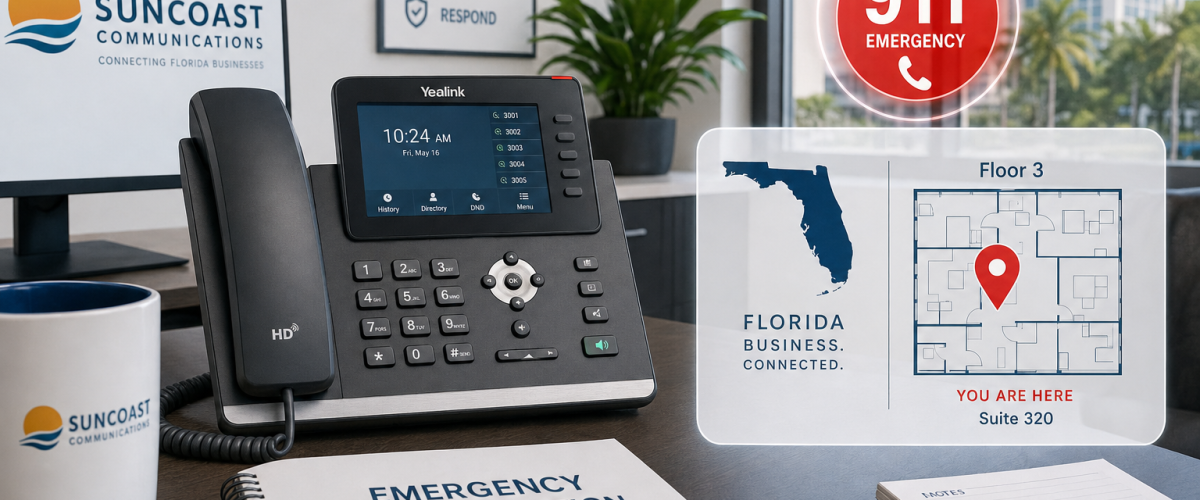
Florida VoIP E911 Requirements for Businesses
Florida VoIP E911 requirements apply to virtually every business that uses a hosted phone system, PBX, or unified communications platform to make and receive calls. Getting this wrong is not just a compliance risk — it can delay emergency response when seconds matter. At Mynians, our team works with Florida businesses every day to ensure their VoIP deployments meet federal and state emergency calling standards before a single phone goes live.
This guide covers what Florida business owners, IT managers, and operations teams need to know about VoIP 911 compliance — from the federal rules that set the baseline to the practical steps required for multi-floor offices, suites, and remote employees. We have structured this as a working reference you can use alongside your IT team or share with your phone system vendor.
What Florida Businesses Need to Know About VoIP E911
Enhanced 911 (E911) for VoIP means more than simply being able to dial 911. It means that when someone at your business calls 911, the public safety answering point (PSAP) receives an accurate, specific location — not just your company’s billing address. For businesses with multiple floors, suites, or remote employees, this distinction is critical.
Florida businesses operating hosted VoIP or on-premises PBX systems are subject to federal FCC rules that have been in effect since 2020 and 2021. The FCC’s VoIP and 911 service guidance outlines the obligations that apply to both service providers and the enterprises that deploy multi-line telephone systems. Understanding both layers — what your provider must do and what your organization must configure — is essential for full compliance.
Our team at Mynians recommends treating E911 compliance as an ongoing operational responsibility, not a one-time setup task. Staff changes, office moves, and remote work arrangements all create new location data requirements that must be updated in your VoIP platform.
Who Must Comply with E911 Requirements in Florida
Any Florida business that deploys a multi-line telephone system (MLTS) — including hosted VoIP, cloud PBX, UCaaS platforms, and on-premises IP PBX systems — is subject to Kari’s Law and Ray Baum’s Act. This includes:
- Office buildings with multiple extensions or departments
- Hotels, healthcare facilities, and educational institutions
- Retail chains and multi-location businesses
- Businesses with remote or hybrid employees using softphones or VoIP desk phones at home
The rules apply regardless of whether your system is hosted in the cloud or installed on-site. If your employees use extensions to make calls, your system qualifies as an MLTS and must comply. You can review the FCC’s VoIP regulatory overview for the full scope of covered systems.
Federal Rules: Kari’s Law and Ray Baum’s Act
Kari’s Law took effect in February 2020. It requires that any MLTS allow users to dial 911 directly — without dialing a prefix like “9” first — and that the system automatically notify a central location (such as a front desk or security station) when a 911 call is placed. The notification must include the caller’s location if technically feasible.
Ray Baum’s Act (Phase 1 effective January 2021 for fixed devices, Phase 2 effective January 2022 for non-fixed and remote devices) requires that a “dispatchable location” be conveyed to the PSAP with every 911 call. A dispatchable location is a validated street address plus additional information such as floor number, suite, room, or other information that helps first responders find the caller quickly.
Core E911 Requirements for Florida Business VoIP
To meet Florida VoIP E911 requirements under current federal rules, your hosted PBX or MLTS deployment must satisfy the following:
- Direct 911 dialing: Every extension must reach 911 without a dialing prefix.
- On-site notification: A designated on-site contact (front desk, security, or similar) must receive an automatic alert when 911 is dialed, including the caller’s location.
- Dispatchable location transmission: Each 911 call must transmit a specific, validated location to the PSAP — not just the company’s main address.
- Remote worker location registration: Employees using VoIP softphones or desk phones outside the office must have a registered location on file, and the system must prompt them to update it when they move.
If you are deploying or upgrading a phone system in Florida and want to confirm your configuration meets these standards, schedule a VoIP compliance review with Mynians before your go-live date.
How to Set Up Dispatchable Location for Your Offices
Dispatchable location is the most technically involved part of E911 compliance for multi-tenant or multi-floor Florida businesses. Here is how to approach it correctly:
- Map your extensions to physical locations. Every extension or device should be assigned to a specific room, suite, or floor — not just a building address.
- Register each location with your VoIP provider’s E911 database. Your provider must submit these records to the national Emergency Services IP Network (ESInet) or equivalent routing infrastructure.
- Configure softphone location prompts for remote workers. When an employee logs in from a new location, the system should prompt them to confirm or update their address before calls are enabled.
- Test 911 routing periodically. Work with your provider to conduct non-emergency test calls (where permitted by your local PSAP) to verify that location data is reaching dispatchers correctly.
- Update records after any office move, renovation, or staffing change. Stale location data is one of the most common compliance gaps we see in Florida businesses.
Common E911 Compliance Mistakes with Hosted VoIP
These are the most frequent E911 compliance gaps our team identifies when auditing Florida business VoIP systems:
- Using a single address for all extensions. Registering only the company’s main address fails the dispatchable location requirement for multi-floor or multi-suite deployments.
- Forgetting remote workers entirely. Employees working from home or traveling are still covered by Ray Baum’s Act Phase 2. Their location must be registered and kept current.
- Not configuring on-site notification. Many businesses enable 911 dialing but never set up the Kari’s Law notification to a front desk or security contact.
- Assuming the provider handles everything. Hosted VoIP providers supply the infrastructure, but location data entry and maintenance is typically the customer’s responsibility.
- Skipping post-move updates. After an office relocation or floor reassignment, extension-to-location mappings must be updated in the E911 database — this does not happen automatically.
Florida VoIP E911 Compliance Checklist
Use this checklist to assess your current phone system’s E911 readiness:
- ☐ All extensions can dial 911 without a prefix
- ☐ On-site 911 notification is configured and tested
- ☐ Each extension has a registered dispatchable location (floor, suite, or room)
- ☐ Remote worker location registration is enabled and prompts are active
- ☐ E911 location records have been updated within the last 12 months
- ☐ Your VoIP provider has confirmed ESInet or equivalent routing for your account
- ☐ A designated staff member is responsible for maintaining location records
If any item is unchecked, contact our Florida VoIP team at Mynians to close the gap before it becomes a liability. You can also review the FCC’s broadband and connectivity guidance to ensure your underlying internet connection supports reliable emergency call delivery.
How Mynians Supports E911 Compliance for Florida Businesses
Mynians provides hosted PBX and business VoIP services to small and mid-sized businesses across Orlando, Tampa, Miami, Jacksonville, and statewide Florida — with E911 compliance built into every deployment. We configure dispatchable location records for each extension during onboarding, set up Kari’s Law on-site notifications, and provide guidance on remote worker location management.
Our team also conducts compliance reviews for businesses that have inherited legacy phone systems or recently migrated to a new UCaaS platform. If your current system was set up before the Ray Baum’s Act Phase 2 deadline or has not been audited since a major office change, there is a meaningful chance your E911 configuration has gaps. To get a clear picture of where your system stands, reach out to our Florida VoIP compliance team for a no-obligation review.
For additional context on VoIP security and network hardening that supports reliable emergency calling, the NIST Special Publication 800-58 on VoIP security is a useful technical reference for IT teams.
Update Log
- May 2026: Article reviewed and updated to reflect current FCC enforcement posture on Ray Baum’s Act Phase 2 and remote worker dispatchable location requirements. Compliance checklist revised.
Frequently Asked Questions
What is the difference between basic 911 and E911 for VoIP?
Basic 911 connects a caller to emergency services but does not automatically transmit location data. E911 (Enhanced 911) transmits the caller’s location — including a dispatchable address — to the public safety answering point, enabling faster emergency response. All Florida business VoIP systems must support E911 under current FCC rules.
Does Kari’s Law apply to cloud-hosted VoIP systems?
Yes. Kari’s Law applies to all multi-line telephone systems, including cloud-hosted VoIP and UCaaS platforms. Any system with multiple extensions that was installed or significantly upgraded after February 16, 2020 must comply.
What is a dispatchable location and why does it matter?
A dispatchable location is a validated street address plus specific location information such as floor number, suite, or room that helps first responders find a caller quickly. Under Ray Baum’s Act, this information must be transmitted to the 911 dispatcher with every emergency call from a business VoIP system.
Are remote workers covered by VoIP E911 requirements?
Yes. Ray Baum’s Act Phase 2, effective January 2022, extended dispatchable location requirements to non-fixed and remote VoIP devices. Employees using softphones or VoIP desk phones at home must have a registered location on file, and the system should prompt them to update it when they change locations.
What happens if my Florida business is not E911 compliant?
Non-compliance with Kari’s Law and Ray Baum’s Act can result in FCC enforcement action. More critically, it can delay emergency response at your facility if dispatchers receive incomplete or inaccurate location data during a 911 call.
Can Mynians help my Florida business become E911 compliant?
Yes. Mynians provides full E911 configuration for Florida businesses, including dispatchable location registration, Kari’s Law on-site notification setup, and remote worker location management. Contact our team to schedule a compliance review.
How often should I update my VoIP E911 location records?
Location records should be reviewed and updated any time your business moves, renovates, reassigns extensions, or adds remote workers. At a minimum, a full audit of all extension-to-location mappings is recommended annually.