
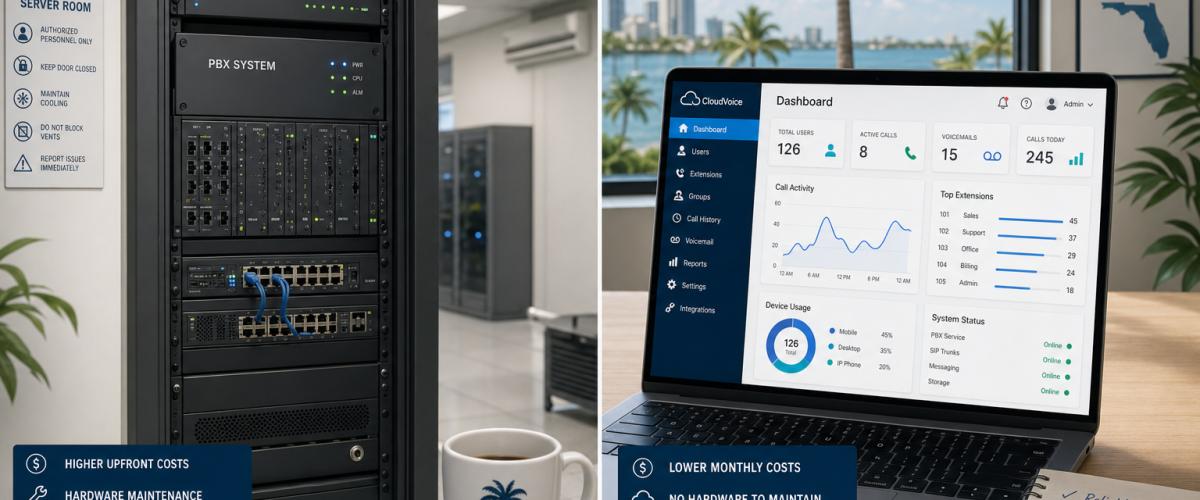
Florida Phone System Cost vs On-Prem PBX
Understanding the true Florida business phone system cost vs on-prem PBX is the most important step before your company commits to any phone infrastructure decision. Many Florida businesses are still running aging PBX hardware that quietly drains budget through maintenance contracts, proprietary parts, and carrier fees that cloud systems have long made obsolete. At Mynians, we work with small and mid-sized Florida businesses every week to map out these real costs and build a migration plan that makes financial sense.
This guide breaks down every cost category that matters when comparing a cloud phone system to on-premise PBX hardware. We cover upfront costs, ongoing fees, hidden expenses, and a practical five-year comparison framework so Florida business owners and IT managers can make an informed decision. The FCC’s VoIP consumer guidance is a useful starting point for understanding regulatory obligations that apply to both deployment types.
What Florida Businesses Need to Compare Before Replacing an Older PBX
Before pulling the trigger on any phone system change, Florida businesses need to look beyond the sticker price. The right comparison accounts for total cost of ownership across at least five years, not just the first invoice. Key variables include number of users, number of physical locations, existing cabling infrastructure, current carrier contracts, and whether your IT team has the capacity to manage on-site hardware.
Florida’s business environment adds specific considerations. Multi-location businesses across Orlando, Tampa, Miami, and Jacksonville often find that connecting remote offices through on-premise PBX requires expensive SIP trunking or dedicated circuits at each site. A hosted VoIP system connects all locations through a single cloud platform, which simplifies both management and billing. Our team at Mynians regularly helps businesses map out these location-specific costs before they commit to a direction.
Florida Business Phone System Total Cost: Cloud vs On-Prem PBX
The total cost of ownership for a business phone system includes every dollar spent from initial purchase through ongoing operation. On-premise PBX systems front-load costs heavily: hardware, licensing, installation, cabling, and configuration all hit before the first call is made. Hosted VoIP systems spread costs over time through monthly per-user fees, which is easier on cash flow but requires a longer view to compare fairly.
For a practical starting point, schedule a VoIP consultation with Mynians so our team can build a cost model specific to your Florida business size and location setup. Generic industry estimates rarely account for Florida-specific carrier pricing, building cabling conditions, or the support costs tied to aging PBX hardware from manufacturers who have discontinued certain product lines.
Upfront Costs: Hardware, Installation, Cabling, and Setup
On-premise PBX systems require a significant capital investment before they go live. A mid-range PBX appliance for a 20-to-50 user business typically requires server hardware, a licensed software platform, physical IP phones or analog adapters, structured cabling if the building is not already wired, and professional installation. These costs stack quickly and are paid before the system handles a single call.
Hosted VoIP systems shift most of this cost away. Phones can be physical IP handsets, softphones on existing computers, or mobile apps. If your team already uses computers and smartphones, the hardware investment can be minimal. Installation is largely remote configuration. Cabling requirements are reduced to a reliable internet connection, which most Florida businesses already have. The FCC broadband speed guide can help you verify whether your current connection meets VoIP requirements before migrating.
Ongoing Costs: Licensing, Support, Maintenance, and Carrier Fees
On-premise PBX ongoing costs include annual software licensing renewals, hardware maintenance contracts, IT staff time for system administration, and separate carrier fees for PSTN connectivity through SIP trunks or PRI circuits. Each of these is a recurring line item that compounds over time.
Hosted VoIP consolidates most of these into a single monthly per-user fee. Carrier connectivity, software updates, security patches, and platform maintenance are all handled by the provider. For Florida businesses without a dedicated IT department, this is a meaningful operational advantage. Our Florida VoIP team at Mynians includes all platform updates, E911 registration, and technical support in the monthly service fee with no surprise add-ons.
Hidden Costs Florida Businesses Often Miss
Several cost categories consistently catch Florida businesses off guard when they evaluate their existing PBX or plan a replacement.
- Hardware refresh cycles: On-premise PBX hardware typically needs replacement every seven to ten years. That capital expense recurs and is often not budgeted in advance.
- E911 compliance: Both on-premise and hosted systems must meet FCC E911 requirements for VoIP. On-premise systems often require additional configuration and ongoing updates to stay compliant as regulations evolve.
- Downtime costs: When on-premise PBX hardware fails, repair timelines depend on parts availability and technician scheduling. Hosted VoIP systems with redundant cloud infrastructure typically restore service faster.
- Remote work gaps: On-premise PBX was not designed for distributed workforces. Adding remote extensions often requires VPN infrastructure or additional licensing that adds cost and complexity.
- Security patching: VoIP security is a real concern. The NIST SP 800-58 guidelines for VoIP security outline the ongoing patching and configuration requirements that on-premise systems must manage internally.
5-Year Cost Comparison by Business Size
The five-year window is the standard benchmark for phone system comparisons because it captures at least one major maintenance cycle for on-premise hardware and provides enough time for hosted VoIP monthly fees to accumulate meaningfully. Businesses with fewer than 50 users almost universally find hosted VoIP less expensive over five years. Businesses with 100 or more users in a single location with stable headcount sometimes find on-premise costs more competitive, but this depends heavily on existing infrastructure and IT staffing.
When On-Prem PBX Still Makes Sense and When It Does Not
On-premise PBX can still be the right choice in specific scenarios: businesses with highly specialized call center integrations tied to legacy software, organizations with strict data sovereignty requirements that prohibit cloud processing, or facilities with unreliable internet connectivity where a local system provides a fallback. These situations are increasingly rare but real.
For the majority of Florida small and mid-sized businesses, on-premise PBX no longer offers a meaningful advantage over hosted VoIP. Modern cloud phone systems provide enterprise-grade features, documented failover plans, and security frameworks that meet or exceed what most businesses can achieve with self-managed hardware. The flexibility to add users, open new locations, and support remote staff without hardware changes is a practical advantage that on-premise systems cannot match at comparable cost.
How to Estimate Your Real Migration Cost and Request a Quote
Estimating your real migration cost starts with a current-state audit: how many users, how many locations, what hardware is in place, what carrier contracts are active, and what features your team actually uses day to day. Many businesses discover during this audit that they are paying for PBX features or carrier capacity they no longer need.
Mynians provides hosted PBX and VoIP service for Florida businesses across Orlando, Tampa, Miami, Jacksonville, and statewide. We handle number porting, E911 registration, phone provisioning, and staff training as part of the migration process. To get a real cost estimate for your business, connect with our Florida VoIP team and we will build a line-by-line comparison against your current phone system costs.
Frequently Asked Questions
What is the main cost difference between hosted VoIP and on-premise PBX for Florida businesses?
On-premise PBX requires large upfront capital for hardware, installation, and cabling, plus ongoing maintenance contracts and carrier fees. Hosted VoIP spreads costs as predictable monthly per-user fees with no hardware purchase required, typically resulting in lower five-year total cost of ownership for businesses under 100 users.
How much does it cost to replace an on-premise PBX with a hosted VoIP system in Florida?
Migration costs vary by business size, number of locations, and existing infrastructure. Mynians provides free cost comparisons for Florida businesses that include number porting, phone provisioning, and setup so you can see the full picture before committing.
Does hosted VoIP meet E911 requirements for Florida businesses?
Yes. The FCC requires VoIP providers to support E911 service. Mynians registers E911 location data for all Florida business accounts as part of the standard service setup, keeping your business compliant without additional configuration on your end.
Can a Florida business keep its existing phone numbers when switching to hosted VoIP?
Yes. Number porting allows Florida businesses to transfer existing phone numbers from their current carrier to a hosted VoIP provider. Mynians manages the porting process for all Florida customers to minimize disruption during the transition.
What internet speed does a Florida business need to run hosted VoIP reliably?
A general guideline is approximately 100 kbps of dedicated bandwidth per concurrent call. The FCC broadband speed guide provides additional context. Most Florida businesses with standard business internet connections already meet VoIP bandwidth requirements.
Is on-premise PBX ever the better choice for a Florida business?
On-premise PBX may still suit businesses with legacy software integrations, strict data sovereignty requirements, or unreliable internet connectivity. For most Florida small and mid-sized businesses, hosted VoIP offers better flexibility, lower total cost, and easier management.
How long does it take to migrate from on-premise PBX to hosted VoIP?
Most migrations for small to mid-sized Florida businesses complete within two to four weeks, depending on number porting timelines and the complexity of existing call routing. Mynians coordinates the full migration process including provisioning, porting, and staff training.
Update Log
- May 2026: Article published with five-year cost comparison framework, hidden cost breakdown, and E911 compliance guidance updated to reflect current FCC requirements for Florida VoIP deployments.