
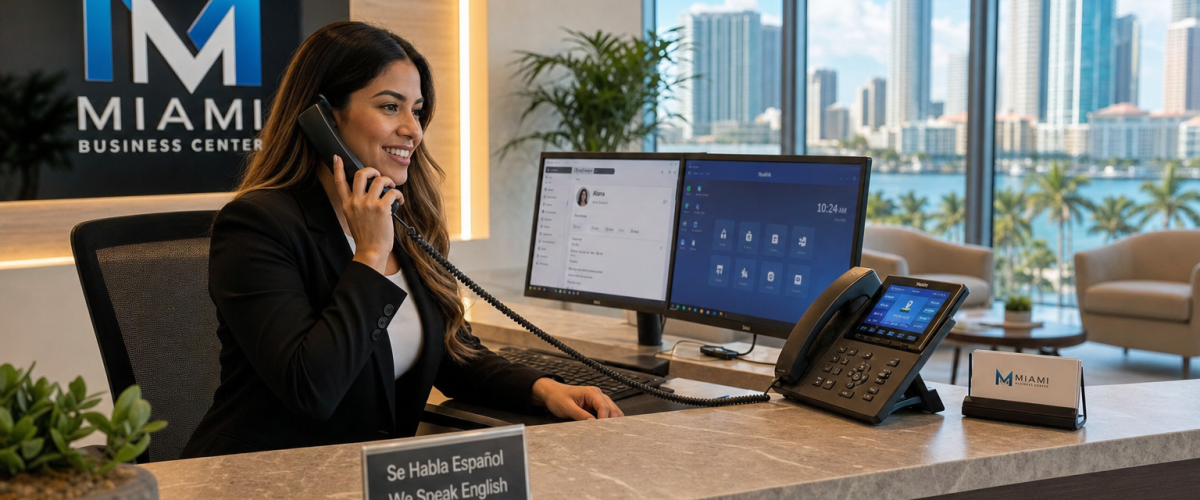
Miami Cloud Phone System for Bilingual Call Routing
A Miami cloud phone system for bilingual business call routing gives your team the tools to serve English- and Spanish-speaking customers without dropped calls, wrong transfers, or frustrated callers. Miami’s diverse customer base means a single-language phone setup leaves real revenue on the table. At Mynians, we build hosted PBX systems specifically configured for bilingual routing so every caller reaches the right person in their preferred language from the very first prompt.
This guide covers the practical mechanics of bilingual call routing on a cloud phone system, the features that matter most for Miami businesses, and the setup steps our team uses when deploying hosted PBX for bilingual environments. Whether you run a medical office in Doral, a law firm in Brickell, or a retail operation in Hialeah, the routing logic is the same — and getting it right makes a measurable difference in caller experience.
Why Miami Businesses Need Bilingual Call Routing
Miami is one of the most bilingual metro areas in the United States. A significant portion of the population conducts daily business primarily in Spanish, and many callers will hang up or not call back if they cannot navigate a phone system in their preferred language. For small and mid-sized businesses, that represents lost appointments, lost sales, and lost trust.
Standard single-language phone systems force Spanish-speaking callers to guess at menu options or wait on hold hoping to find someone who can help them. A properly configured Miami cloud phone system solves this at the IVR layer before a human agent is ever involved. The caller selects their language in the first five seconds, and every subsequent prompt, queue message, and hold music track plays in that language.
Beyond customer experience, bilingual routing also helps your staff. When agents know a call is coming from the Spanish queue, they can answer prepared. That reduces handle time and improves confidence on both sides of the call.
How a Cloud Phone System Handles English and Spanish Callers
A hosted PBX cloud phone system routes calls using a combination of an IVR (interactive voice response) menu, call queues, and agent groups. For bilingual routing, the IVR is the entry point. When a caller dials your main business number, they hear a greeting in both languages — typically something like “For English, press 1. Para Español, oprima 2.”
From that selection, the system branches into two parallel routing trees. Each tree has its own queue, its own hold messages, and its own agent group. If no Spanish-speaking agent is available, the overflow rule can send the caller to voicemail with a Spanish-language prompt, or to a secondary queue, rather than silently timing out.
The FCC’s overview of VoIP technology explains that hosted VoIP systems operate over broadband internet, which means all of this routing logic lives in the cloud — no on-site PBX hardware required. Changes to greetings, queue assignments, or routing rules can be made from a web portal in minutes.
Core Features to Look for in a Bilingual Business Phone System
Not every cloud phone system is built with bilingual routing in mind. When evaluating a hosted PBX for a Miami business, these are the features that matter most for English and Spanish call handling.
- Multi-language IVR: The auto attendant must support separate audio files per language branch, not just a single greeting with a language toggle.
- Language-specific call queues: Each language should have its own queue with independent hold music, position announcements, and overflow rules.
- Agent skill groups: Agents should be assignable to one or both language queues based on their fluency, with priority weighting if needed.
- Custom voicemail per queue: Spanish-language callers should reach a Spanish-language voicemail box, not a generic English prompt.
- Real-time queue monitoring: Supervisors need visibility into both queues simultaneously to manage staffing during peak hours.
- Call recording by queue: Recording calls per language queue makes quality review and compliance much easier.
Mynians provides all of these features as part of our standard hosted PBX configuration for Miami businesses. Our team handles the initial setup, records or sources bilingual audio files, and tests every routing path before go-live.
Sample Bilingual Call Flow for Miami Businesses
Understanding the routing logic is easier with a concrete example. Below is a typical bilingual call flow our team configures for Miami small businesses.
The key design principle is that the language selection happens once, at the top of the call, and every subsequent touchpoint — hold messages, transfers, voicemail — respects that selection. Callers should never have to re-state their language preference mid-call.
For multi-location businesses, the same cloud PBX can route Miami callers to a Spanish-speaking agent in any office, not just the one they called. This is one of the practical advantages of a hosted system over a traditional on-site PBX.
How to Set Up Auto Attendants, Queues, and Routing Rules
Setting up a bilingual auto attendant on a hosted PBX involves five practical steps. Our team at Mynians walks every Miami client through this process during onboarding.
- Define your language branches: Decide which departments or services need bilingual access. Not every menu option requires a Spanish path — map only what your callers actually need.
- Record professional audio files: Create separate audio files for each language branch. This includes the main greeting, queue hold messages, position announcements, and voicemail prompts.
- Build agent skill groups: Assign agents to the English queue, the Spanish queue, or both. Set overflow rules so calls never dead-end.
- Configure queue overflow: Decide what happens when no agent is available — voicemail, callback option, or transfer to a secondary queue. Set maximum wait times for each language queue independently.
- Test every path: Call the main number and walk through every branch before going live. Test overflow scenarios by simulating all agents being busy.
The NIST Special Publication 800-58 on VoIP security is worth reviewing during setup — it covers network segmentation and access control practices that apply to any hosted PBX deployment, including bilingual systems handling sensitive customer data.
If your business needs to meet specific compliance requirements — for example, a healthcare practice handling patient calls in both languages — our team can configure the system to align with those requirements from the start. Reach out to our Florida VoIP team to discuss your specific setup before you begin.
Common Mistakes That Frustrate Bilingual Callers
Even well-intentioned bilingual phone setups fail when these common mistakes are made.
- Using text-to-speech for Spanish prompts: Automated Spanish voices often mispronounce words or use regional phrasing that sounds unnatural to Miami callers. Record with a human voice.
- Routing Spanish callers to a general queue: If Spanish-speaking callers end up in the same queue as English callers, the language selection was meaningless. Each language needs its own queue.
- No Spanish-language voicemail: Sending a Spanish-speaking caller to an English voicemail prompt after a long hold is a poor experience. Every queue needs a matching voicemail box.
- Forgetting overflow rules: A queue with no overflow rule will eventually time out and disconnect the caller. This is the most common complaint we hear from businesses switching to Mynians from a previous provider.
- Not testing after changes: Any time a greeting, agent assignment, or routing rule is updated, the full call path should be re-tested in both languages.
The FCC’s guidance on VoIP and 911 service is also relevant here — businesses should confirm that E911 registration is current whenever phone system changes are made, regardless of language configuration.
What Success Looks Like After Deployment
A well-deployed bilingual cloud phone system produces measurable improvements in call handling. Abandoned call rates drop because callers reach the right queue faster. First-call resolution improves because agents are prepared for the language of the incoming call. Voicemail retrieval rates improve because messages are left in the caller’s language.
For Miami businesses, the broader benefit is customer trust. When a Spanish-speaking caller navigates your phone system smoothly and reaches a bilingual agent without confusion, that experience reflects directly on your brand. It signals that your business is built for the community it serves.
Mynians provides ongoing support after deployment — including audio file updates, routing adjustments, and queue monitoring — so your bilingual phone system stays current as your business grows. We serve small and mid-sized businesses across Miami, Orlando, Tampa, Jacksonville, and statewide Florida.
For additional context on broadband requirements that support reliable VoIP call quality, the FCC broadband speed guide provides useful benchmarks for businesses evaluating their internet connection before deploying a cloud phone system.
Frequently Asked Questions
What is a bilingual cloud phone system for Miami businesses?
A bilingual cloud phone system is a hosted VoIP PBX that routes English and Spanish callers into separate queues using a multi-language IVR auto attendant. Mynians configures these systems for Miami small and mid-sized businesses with custom greetings, agent groups, and overflow rules for each language.
How does IVR call routing work for Spanish and English callers?
When a caller dials your main number, the IVR plays a dual-language greeting and asks the caller to press a number for their preferred language. The system then routes the call to the appropriate language-specific queue and agent group, keeping all subsequent prompts in the selected language.
Do I need special hardware for a bilingual VoIP phone system in Miami?
No. A hosted cloud PBX runs over your existing broadband internet connection. All routing logic, IVR menus, and call queues are managed in the cloud. You need compatible IP desk phones or a softphone app, but no on-site PBX hardware is required.
Can a cloud phone system route calls to bilingual agents across multiple Miami locations?
Yes. A hosted PBX treats all locations as part of the same phone system. A Spanish-speaking caller who dials your Miami office can be routed to a bilingual agent at any connected location, including other Florida offices, based on availability and skill group assignment.
What happens if no Spanish-speaking agent is available?
Overflow rules determine the outcome. Common options include routing the caller to a Spanish-language voicemail box, offering a callback option, or transferring to a secondary queue. Mynians configures overflow rules for every language queue during setup to prevent callers from being silently disconnected.
How long does it take to set up a bilingual phone system for a Miami business?
Most small business deployments are completed within one to two weeks, including IVR recording, queue configuration, agent setup, and testing. Timeline depends on the number of locations, agents, and the complexity of the routing rules required.
Is a bilingual VoIP system more expensive than a standard business phone system?
The core cost of a hosted PBX does not increase significantly for bilingual routing. The primary added cost is professional audio recording for Spanish-language greetings and prompts. Mynians includes bilingual IVR configuration as part of standard onboarding for Miami business clients.
Update Log
- May 2026: Article published covering bilingual IVR call routing, auto attendant setup, queue overflow rules, and common mistakes for Miami cloud phone system deployments. Content reflects current Mynians hosted PBX feature set for Florida businesses.