
VoIP vs Traditional Phone Lines in Florida
If your Florida office is still running on copper landlines or an aging PBX cabinet, you have probably felt the friction: confusing carrier bills, weeks-long waits for new lines, dropped calls during summer storms, and zero flexibility when staff work remotely. This guide breaks down the real differences between VoIP and traditional business phone lines so you can make a confident decision for your growing office.
Side-by-Side Comparison: VoIP vs Traditional Phone Lines
Before diving into the details, here is a practical snapshot of how the two options compare across the factors Florida business owners ask about most.
| Factor | Hosted VoIP (Mynians) | Traditional Landline / Legacy PBX | National VoIP (RingCentral, Nextiva) |
|---|---|---|---|
| Starting price per line | From $22.95/line/mo (Essential, 5-line min) | Varies; often $40–$80+/line with carrier fees | Typically $20–$35+/line; annual contracts common |
| Contract required | No — month-to-month | Often 1–3 year carrier agreements | Often annual; early-termination fees apply |
| Install timeline | 72-hour install (site-ready) | 2–6 weeks for new lines or PBX changes | Self-provisioned or 1–3 weeks with support |
| Remote / mobile use | Full softphone on mobile and desktop | Not supported without costly add-ons | Yes, app-based |
| Hurricane / outage failover | Configured failover and call rerouting | Lines go down with physical infrastructure | Cloud-based but no local failover config support |
| Number porting | Handled end-to-end by Mynians team | N/A (you already own the lines) | Customer-managed; support varies |
| Support model | Local Orlando-based team, not a call center | National carrier support queues | National call center; tiered ticket system |
| Multi-location call routing | Included; cloud PBX handles it natively | Requires expensive inter-office trunking | Available but self-configured |
| HIPAA-compliant call flows | Available for healthcare offices | Not available natively | Available on higher-tier plans |
| Uptime SLA | No percentage published; outage and failover plan in writing | Carrier-dependent; no SLA for SMBs typically | 99.999% published; enforcement varies |
What Is Business VoIP?
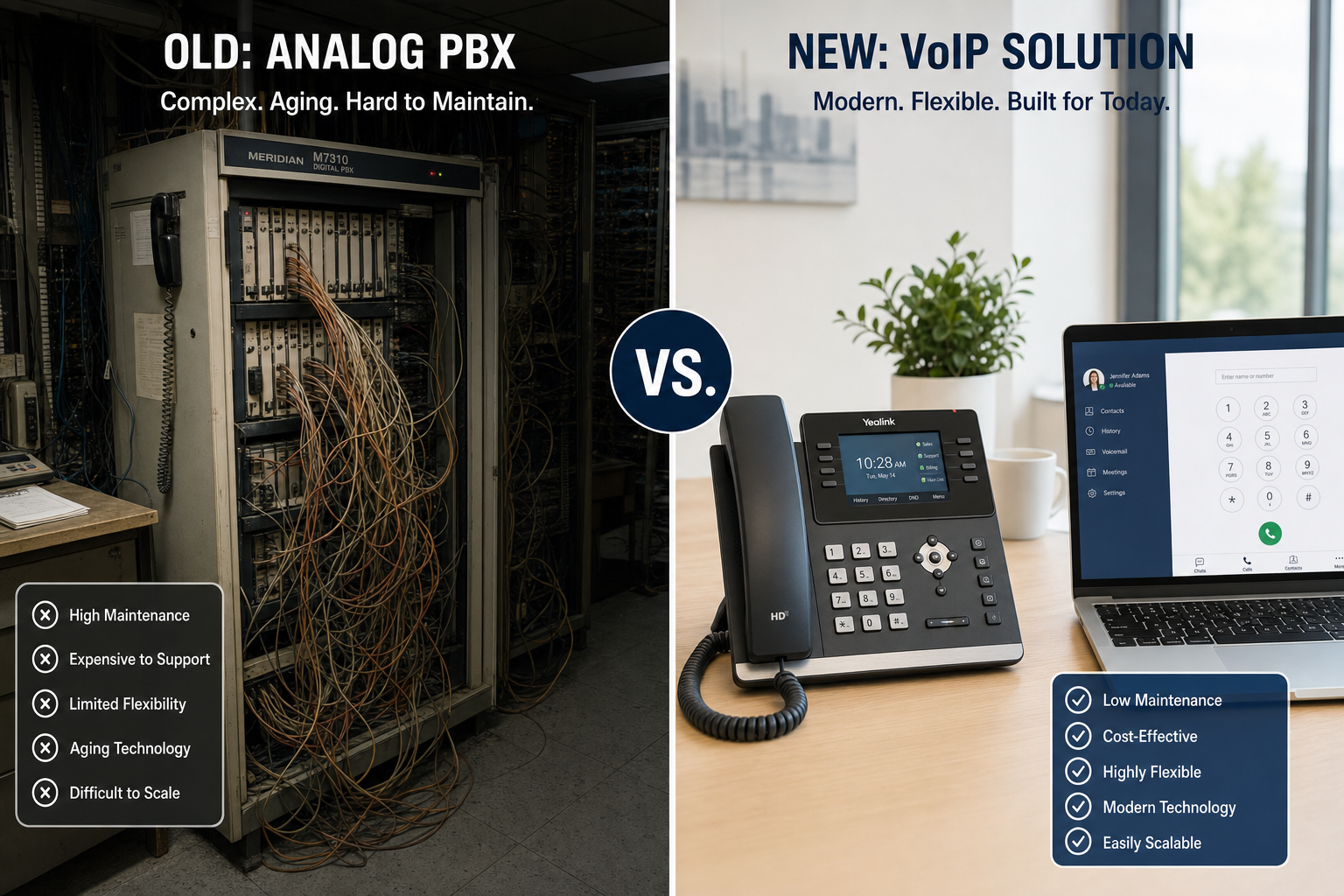
VoIP — Voice over Internet Protocol — routes your business calls over your internet connection instead of copper telephone wires. A hosted VoIP system means the phone system infrastructure lives in the cloud, managed by your provider. Your office gets physical desk phones, softphone apps on laptops and mobile devices, and a full feature set including auto-attendants, call queues, voicemail to email, and call routing — all without a PBX cabinet bolted to your server room wall.
For a growing Florida office, the practical upside is straightforward: add a line in minutes, not weeks. Move an employee to a new location without rewiring. Route calls to a mobile phone when the office is closed for a storm. The FCC has published guidance on how VoIP services are classified and what consumer protections apply, which is worth reviewing if you are comparing regulatory obligations between service types.
Hosted VoIP vs On-Premise VoIP
Some businesses confuse hosted VoIP with on-premise IP-PBX systems. An on-premise IP-PBX still requires hardware at your location and an internal IT team to manage it. Hosted VoIP moves that responsibility to the provider. For most Florida SMBs without a dedicated IT staff, hosted is the practical choice.
What Are Traditional Business Phone Lines?
Traditional business phone service runs over the Public Switched Telephone Network (PSTN) — the copper wire infrastructure that has been in the ground for decades. Most Florida businesses on legacy systems are running one of three setups: plain old telephone service (POTS) lines, a key system, or an on-premise PBX.
The problems are well-documented by anyone who has tried to add lines to a growing office. A new line often means a carrier truck roll, a two-to-six-week provisioning window, and a bill that includes per-line charges, feature add-ons, long-distance fees, and taxes that can make the actual cost hard to read. When the PBX hardware fails, you are calling a vendor who may or may not have parts for a system that is five to fifteen years old.
Key Differences That Matter to Florida Offices
Flexibility and Scalability
Traditional lines scale slowly. Adding five lines to a legacy PBX can mean ordering hardware, scheduling a technician, and waiting weeks. With hosted VoIP, adding a line is a configuration change. For a law firm in Orlando opening a second office in Tampa, or a medical practice in Jacksonville adding a new provider, that difference is not minor — it is the difference between being operational in days versus weeks.
Mobility and Remote Work
Legacy landlines are fixed to a physical location. If your staff works from home, travels, or splits time between offices, traditional lines require expensive forwarding setups or separate mobile plans. VoIP softphones run on any smartphone or laptop. Your employee in Winter Garden answers calls on the same business number whether they are at the desk or working from home during a hurricane evacuation.
Reliability and Redundancy
This is where Florida’s geography matters. Copper lines go down in storms. A flooded junction box or a downed utility pole takes your phones with it. A properly configured hosted VoIP system with failover routing can redirect calls to mobile numbers or a secondary location automatically. Your callers reach a live person or a professional auto-attendant even when your physical office is unreachable. The Cybersecurity and Infrastructure Security Agency (CISA) recommends that businesses maintain communications continuity plans — VoIP failover is a direct implementation of that guidance.
Feature Set
Auto-attendants, call queues, voicemail to email, call recording, and ring groups are standard on hosted VoIP. On a legacy PBX, many of these features require additional hardware modules or licensing. On POTS lines, most are simply unavailable.
Florida-Specific Considerations
Hurricane Season and Outage Planning
Florida businesses face a communication risk that offices in other states do not think about as often. Hurricane season runs June through November. A Category 1 storm can knock out power and copper infrastructure for days. A hosted VoIP system with properly configured failover means your calls route to mobile devices or an alternate site automatically. Your front desk does not go dark just because the building does.
Multi-Location Operations
Florida businesses frequently operate across multiple markets — an Orlando headquarters with satellite offices in Tampa, Miami, or Jacksonville. Connecting those locations on a traditional PBX requires inter-office trunking, which is expensive and inflexible. Cloud PBX handles multi-location call routing natively. Transfers between locations, shared call queues, and unified auto-attendants work the same way whether your team is in one building or four.
HIPAA-Compliant Call Flows
Healthcare practices across Florida — medical offices, dental practices, behavioral health providers — have specific requirements for how patient calls are handled and recorded. Mynians VoIP supports HIPAA-compliant call flows for healthcare clients. This is not something a standard POTS line or a generic national VoIP plan handles out of the box.
Front-Desk Overload and After-Hours Routing
A busy reception desk in a growing office is a real operational problem. Auto-attendants and call queues distribute inbound volume without requiring additional headcount. After-hours routing sends calls to voicemail, an on-call mobile, or a recorded message — automatically, without anyone staying late to forward the phones.
Who VoIP Is For — and Who It Is Not
VoIP Is a Strong Fit If You:
- Have five or more lines and want predictable per-line pricing
- Are opening a second location in Florida and need unified call routing
- Have staff who work remotely or travel regularly
- Are tired of waiting weeks for carrier changes or new lines
- Want auto-attendants, call queues, or voicemail to email without paying for add-on modules
- Need a phone system that stays up when a storm hits your building
- Run a healthcare practice and need HIPAA-compliant call handling
VoIP May Not Be the Right Move If You:
- Have a single-line home-based business with minimal call volume (a basic residential VoIP or mobile plan may be sufficient)
- Have an internet connection that is genuinely unreliable with no upgrade path — though this is increasingly rare in Florida metro markets
- Operate specialized equipment that requires analog POTS lines, such as certain alarm systems, fax machines, or elevator emergency phones (these can often be handled with analog adapters, but it requires an honest assessment)
If you are unsure which category you fall into, a quick network readiness check before committing to any system is the right first step. Mynians handles that as part of the consultation process.
Number Porting: What Can Go Wrong
Keeping your existing business phone numbers when you switch providers is called number porting. It is governed by FCC rules that require carriers to release numbers, but the process has real failure points that leave businesses unreachable if it is not managed carefully.
Common Porting Problems
- Incorrect account information: The losing carrier will reject a port request if the name, address, or account number does not match their records exactly.
- Premature cancellation: Canceling your old service before the port completes can permanently lose your number.
- Partial ports: In multi-line accounts, some numbers port while others stall, leaving your call routing broken mid-migration.
- No confirmation of completion: Without active monitoring, a port can sit in a failed state for days before anyone notices.
Mynians handles number porting end-to-end. That means we submit the request, track it, coordinate with the losing carrier, and confirm completion before we consider the job done. You do not manage the paperwork or make calls to your old carrier.
Why Local Support Changes Everything
National VoIP providers are not bad products. But when something goes wrong — a misconfigured call queue, a porting issue, a network problem affecting call quality — you are opening a ticket with a call center that has no idea what your office looks like, who your internet provider is, or what your cabling situation is.
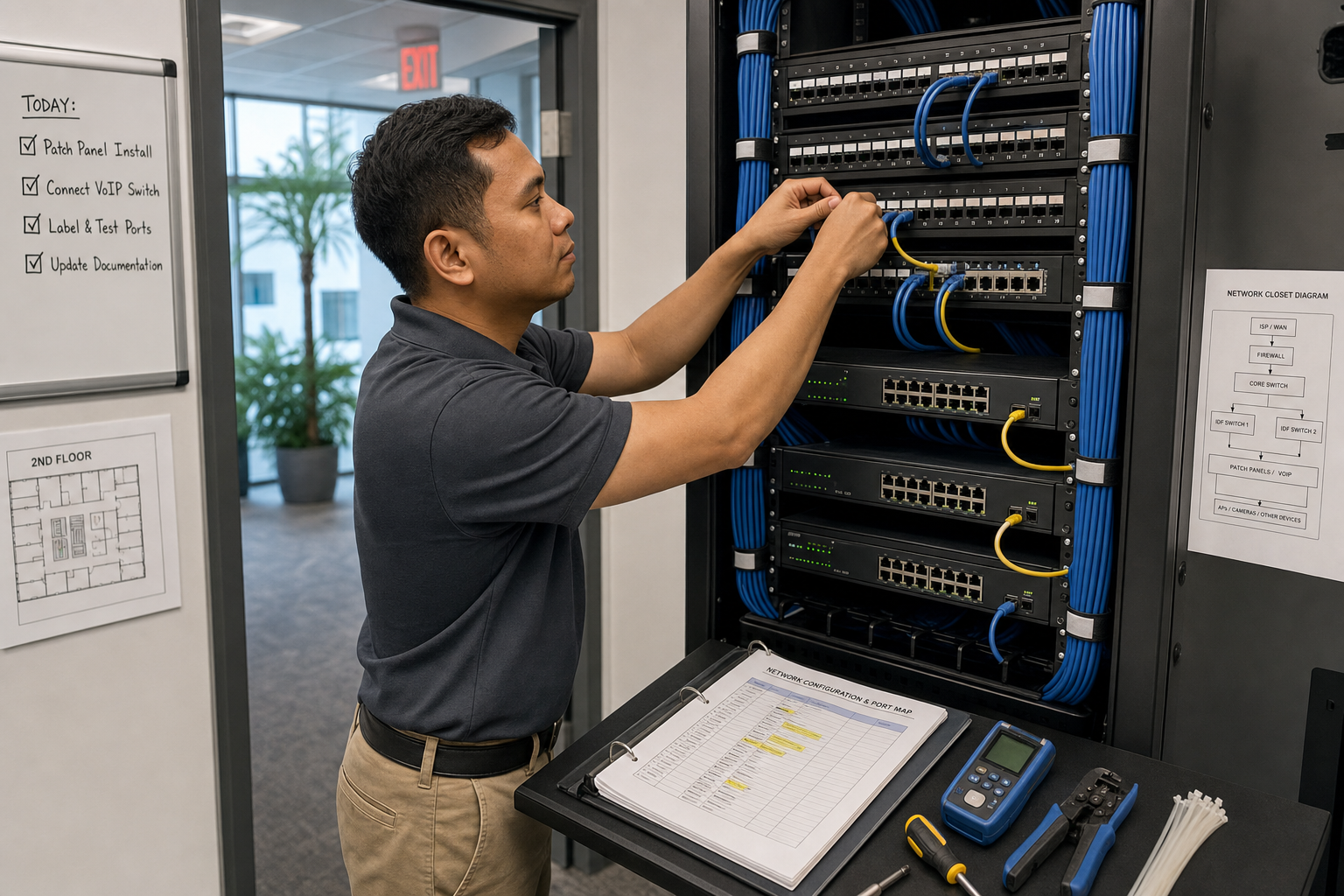
Mynians is a Winter Garden, Florida technology company in business since 2007. Our VoIP team is the same team that handles managed IT, structured cabling, and network readiness for Florida businesses. When a call quality problem turns out to be a switch configuration issue or a cabling problem in your network closet, we do not hand you off to a different vendor. We fix it.
We serve businesses across Orlando, Winter Garden, Tampa, Miami, Jacksonville, and the surrounding Florida markets. When you call us, you reach real techs with real answers — not a tiered support queue in another time zone.
If you are evaluating your options for Florida business VoIP, the support model is worth weighing as carefully as the price per line.
Understanding Per-Line Pricing
One of the most common frustrations with traditional carrier bills is that the per-line cost is almost never the actual cost. Regulatory recovery fees, long-distance charges, feature bundle add-ons, and taxes can push a line that looks like $30 on the surface to $55 or more by the time the bill arrives.
Mynians VoIP publishes clear per-line pricing with no surprise bills:
- Essential: $22.95 per line per month (5-line minimum)
- Professional: $29.95 per line per month
- Enterprise: $39.95 per line per month (10-line minimum)
All plans are month-to-month with no contracts. The free consultation includes a bill review where we compare your current carrier costs against a line-by-line Mynians quote. Exact savings depend on your current setup, which is why we review the actual bill rather than publishing a generic comparison number.
You can review plan details on the Mynians VoIP pricing page before the consultation if you want to come prepared.
What the Free Consultation Covers
- Review of your current carrier bill, line by line
- A quote matched to your actual line count and feature needs
- Network readiness assessment to confirm your internet connection supports VoIP quality
- Discussion of porting timeline and what to expect during the switch
- No obligation, no pressure — just a clear picture of your options
Call us at (407) 374-2782 or visit our contact page to get started.
Frequently Asked Questions
How much does business VoIP cost compared to traditional phone lines in Florida?
Mynians VoIP plans start at $22.95 per line per month on the Essential plan with a 5-line minimum, with no contracts. Traditional carrier bills for business lines often include regulatory fees, feature add-ons, and long-distance charges that push the real per-line cost significantly higher. The free Mynians consultation includes a bill review that compares your current carrier charges against a line-by-line VoIP quote so you can see the actual difference for your office.
How long does it take to switch from traditional phone lines to VoIP in Florida?
Mynians completes installs within 72 hours across major Florida markets when the site is ready. Site readiness means your internet connection meets VoIP quality requirements and your network is configured correctly. Mynians handles the network readiness check as part of the process. Number porting timeline depends on your current carrier but is managed end-to-end by the Mynians team.
Will I keep my existing business phone numbers when I switch to VoIP?
Yes. Number porting is included and handled end-to-end by Mynians. We submit the port request, track it with your current carrier, and confirm completion before the migration is considered done. You do not need to manage the paperwork or coordinate with your old carrier.
What happens to my phones during a hurricane or power outage in Florida?
A properly configured hosted VoIP system with failover routing can automatically redirect calls to mobile devices or a secondary location when your physical office loses power or connectivity. Traditional copper landlines go down with the physical infrastructure and have no automatic rerouting capability. Mynians configures failover as part of the system setup for Florida clients.
Does Mynians VoIP require a long-term contract?
No. All Mynians VoIP plans are month-to-month with no contracts. You are not locked into a multi-year agreement. This is different from many national VoIP providers and traditional carriers who require one- to three-year commitments with early termination fees.
Can VoIP handle HIPAA-compliant call flows for a Florida healthcare practice?
Yes. Mynians VoIP supports HIPAA-compliant call flows for healthcare offices including medical practices, dental offices, and behavioral health providers. This is configured as part of the system setup and is not available on standard POTS lines or most entry-level national VoIP plans.
What is the difference between Mynians VoIP and a national provider like RingCentral or Nextiva?
The primary difference is support and local expertise. National providers route support through tiered call centers with no knowledge of your specific office, network, or cabling situation. Mynians is a Winter Garden, Florida technology company in business since 2007. The same local team that installs your VoIP system also handles managed IT, structured cabling, and network readiness. When a problem turns out to be a network or cabling issue rather than a phone configuration issue, Mynians resolves it without handing you off to another vendor.
Update Log
- July 2026: Created and reviewed for Mynians VoIP business phone system accuracy.