
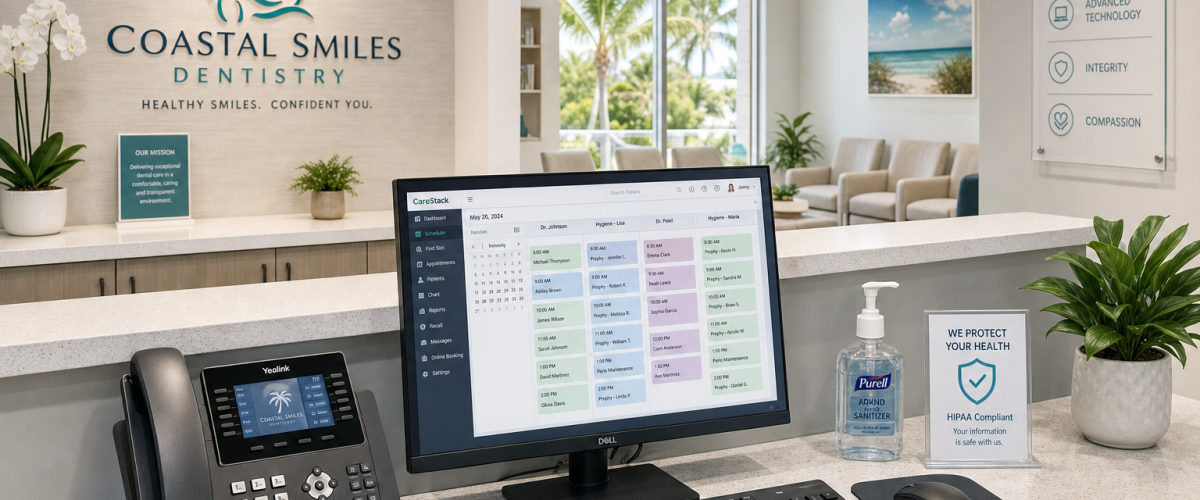
HIPAA-Compliant VoIP for Florida Dental Offices
HIPAA-compliant VoIP for Florida dental offices is no longer optional — it is a regulatory baseline that every practice must meet before transmitting patient information over a phone system. Florida dental offices face both federal HIPAA enforcement and a patient base that expects privacy at every touchpoint. At Mynians, we help dental practices across Orlando, Tampa, Miami, and Jacksonville replace legacy phone systems with secure, hosted VoIP solutions built around compliance from day one.
This guide is written for dental office managers, practice owners, and operations staff responsible for phone system decisions. The information draws on published HHS HIPAA Security Rule guidance and FCC VoIP consumer guidance. No legal advice is provided here — consult your compliance officer or healthcare attorney for practice-specific decisions.
Why Florida Dental Offices Need HIPAA-Compliant VoIP
Dental offices handle protected health information (PHI) on nearly every call — appointment scheduling, insurance verification, treatment follow-ups, and prescription coordination all involve patient data. Under the HIPAA Security Rule, any electronic system that transmits, stores, or processes PHI must meet specific safeguard requirements. VoIP phone systems are no exception.
Florida adds additional context. The state has a large and growing senior population, a high concentration of multi-location dental groups, and active enforcement activity from the HHS Office for Civil Rights. A phone system breach or an improperly configured voicemail box can trigger an OCR investigation with significant financial penalties. Switching to a HIPAA-compliant VoIP system is the most direct way to close that exposure.
Legacy landline systems were not designed with HIPAA in mind. They lack call encryption, audit logs, and the access controls the Security Rule requires. Cloud-hosted VoIP, when properly configured, addresses all three gaps.
What Makes a VoIP Phone System HIPAA Compliant
HIPAA compliance for a VoIP system is not a single feature — it is a combination of technical safeguards, administrative controls, and a contractual relationship with your provider. The HIPAA Security Rule identifies three categories of safeguards: administrative, physical, and technical.
For a VoIP phone system, the most critical technical requirements include:
- Encrypted voice transmission: Calls carrying PHI must be encrypted in transit using protocols such as SRTP (Secure Real-time Transport Protocol) and TLS (Transport Layer Security).
- Secure voicemail storage: Voicemail messages that contain patient information must be stored in an encrypted, access-controlled environment.
- Audit logging: The system must maintain records of who accessed call data, when, and from which device.
- User access controls: Each staff member should have individual credentials. Shared extensions without authentication create compliance gaps.
- Business Associate Agreement (BAA): Your VoIP provider is a business associate under HIPAA. A signed BAA is legally required before the system goes live.
At Mynians, our hosted PBX platform includes all of these controls as standard configuration for dental and healthcare clients. BAA availability is confirmed in writing for your specific service before you sign.
Must-Have Features for Dental Practice Phone Security
Beyond the baseline HIPAA requirements, dental offices benefit from specific VoIP features that support both compliance and daily operations.
- Auto-attendant with HIPAA-aware call routing: Route calls to the correct department without exposing patient information in hold queues or transfer announcements.
- Secure fax (eFax): Many dental offices still receive insurance documents and referrals by fax. A HIPAA-compliant eFax solution eliminates the physical fax machine and its associated risks.
- Call recording with access controls: Recorded calls must be stored securely and accessible only to authorized staff. Recording retention policies should align with your practice’s data governance plan.
- Mobile softphone with encryption: Dentists and office managers who take calls on mobile devices need an encrypted softphone app, not a forwarded personal cell number.
- E911 registration: The FCC requires VoIP providers to support E911, and each physical office location must be registered so emergency services can locate the correct address.
Florida-Specific Considerations for Dental Communications
Florida dental offices operate in a regulatory environment that combines federal HIPAA requirements with state-level patient privacy protections. Florida Statute 456.057 governs patient record access and disclosure, and it applies to communications as well as written records. A VoIP system that logs and encrypts calls helps demonstrate compliance with both frameworks.
Multi-location dental groups in Florida face an additional layer of complexity. Each office location must have its own E911 registration, and call routing between locations must maintain the same encryption standards as external calls. A hosted PBX system managed centrally — as Mynians provides — simplifies this by applying consistent security policies across all locations from a single administrative console.
Florida also has a high volume of Spanish-speaking patients, particularly in Miami-Dade, Broward, and Orange counties. A compliant VoIP system should support multilingual auto-attendant prompts without routing calls through unsecured third-party translation services.
Common Mistakes Dental Offices Make When Switching Phone Systems
Switching phone systems is a common source of compliance gaps. These are the mistakes we see most often when Florida dental offices transition to VoIP without proper guidance.
- Skipping the BAA: Selecting a VoIP provider based on price alone, without confirming they will execute a BAA, is the single most common compliance error.
- Porting numbers without a transition plan: Number porting can leave a practice unreachable for hours or days if not coordinated properly. Patient appointment reminders and recall calls are disrupted, and staff may revert to personal phones — creating PHI exposure.
- Using consumer VoIP apps: Apps like Google Voice or WhatsApp are not HIPAA-compliant and should never be used for patient communications in a dental office.
- Ignoring voicemail security: Default voicemail configurations on many VoIP platforms do not encrypt stored messages. This must be explicitly enabled and verified.
- Failing to train staff: A compliant system is only as secure as the people using it. Staff must understand which communication channels are approved for PHI and which are not.
Implementation Checklist for a Secure Dental VoIP Rollout
Use this checklist when planning a VoIP transition for your Florida dental office.
- Confirm your VoIP provider will sign a Business Associate Agreement before go-live.
- Verify that voice transmission uses SRTP and TLS encryption end-to-end.
- Register every physical office location for E911 with your provider.
- Configure individual user credentials for every staff member — no shared extensions without authentication.
- Enable encrypted voicemail storage and set a retention policy consistent with your records management plan.
- Set up secure eFax to replace physical fax machines handling insurance and referral documents.
- Test call routing, hold music, and auto-attendant scripts to ensure no PHI is exposed in queue announcements.
- Train all staff on approved communication channels and the practice’s VoIP acceptable use policy.
- Schedule a post-launch audit at 30 days to review call logs, access records, and any configuration drift.
Our team at Mynians walks Florida dental offices through each of these steps during onboarding. We also provide documentation to support your HIPAA risk assessment. To get started, schedule a free consultation with our Florida VoIP team.
When to Schedule a Consultation for Your Practice
The right time to evaluate your phone system is before a compliance audit — not after one. If your current system lacks a signed BAA, uses unencrypted voicemail, or relies on consumer apps for any patient communication, those gaps should be addressed immediately.
Mynians configures healthcare call handling for Florida dental offices — encrypted call paths, controlled voicemail access, recording controls, E911 registration and hosted PBX configuration — with BAA availability confirmed in writing before you sign. We serve single-location practices and multi-site dental groups across the state. The next step is a conversation with our team — not a vendor comparison spreadsheet.
Frequently Asked Questions
Does a dental office VoIP system need to be HIPAA compliant?
Yes. Any phone system used to transmit, store, or process protected health information in a dental office must meet HIPAA Security Rule requirements. This includes encrypted voice transmission, secure voicemail, audit logging, and a signed Business Associate Agreement with the VoIP provider.
What is a Business Associate Agreement and why does my dental office need one?
A Business Associate Agreement (BAA) is a legally required contract between a covered entity — such as a dental practice — and any vendor that handles PHI on its behalf. Your VoIP provider is a business associate under HIPAA. Without a signed BAA, your practice is out of compliance regardless of the system’s technical configuration.
Is standard VoIP from a consumer provider like Google Voice HIPAA compliant?
No. Consumer VoIP services such as Google Voice do not offer Business Associate Agreements and are not designed for HIPAA-regulated environments. Florida dental offices should use a business VoIP provider that explicitly supports healthcare compliance, such as Mynians.
How does E911 work for a dental office using VoIP?
The FCC requires VoIP providers to support Enhanced 911 (E911), which transmits the caller’s registered address to emergency services. Each physical office location must be individually registered with your VoIP provider so that 911 calls route to the correct address. Mynians handles E911 registration for all client locations during onboarding.
Can a multi-location dental group use a single VoIP system across all offices?
Yes. A hosted PBX system can serve multiple office locations under a single administrative platform, with consistent security policies, centralized BAA coverage, and unified call routing. Each location still requires its own E911 registration. Mynians configures multi-site hosted PBX deployments for Florida dental groups statewide.
What encryption protocols should a HIPAA-compliant dental VoIP system use?
HIPAA-compliant VoIP systems should use SRTP (Secure Real-time Transport Protocol) for voice encryption in transit and TLS (Transport Layer Security) for signaling. Voicemail storage should be encrypted at rest. Confirm these protocols are active — not just available — before go-live.
Update Log
- May 2026: Article published covering HIPAA VoIP requirements for Florida dental offices, including BAA guidance, E911 compliance, and implementation checklist aligned with current HHS Security Rule guidance.