
Understanding VoIP Total Cost for Florida Businesses
Florida business VoIP total cost of ownership is one of the most important figures any finance-minded buyer should calculate before signing a service contract. VoIP systems replace traditional phone lines with internet-based calling, but the true cost extends well beyond the monthly per-seat fee. Understanding every cost layer helps Florida businesses make accurate budget decisions and avoid surprises.
The total cost of ownership for a Florida business VoIP system typically includes hardware, licensing, installation, ongoing support, and network upgrades. When calculated correctly over a 36-month period, most small and mid-sized Florida businesses find VoIP delivers 30 to 50 percent lower communication costs compared to legacy landline systems.
Last Updated: March 2026
Disclosure: Some tools mentioned in this guide may have affiliate relationships. These relationships do not influence editorial recommendations.
Table of Contents
- What is VoIP and How Does it Work?
- Understanding Total Cost of Ownership
- Breakdown of VoIP Costs for Florida Businesses
- Hidden Costs in VoIP Services
- Comparing VoIP Providers in Florida
- Maximizing ROI on VoIP Solutions
- Case Study
- Common Mistakes Florida Businesses Make
- Practical Steps to Evaluate VoIP Costs
- Frequently Asked Questions
- Update Log
Key Takeaways
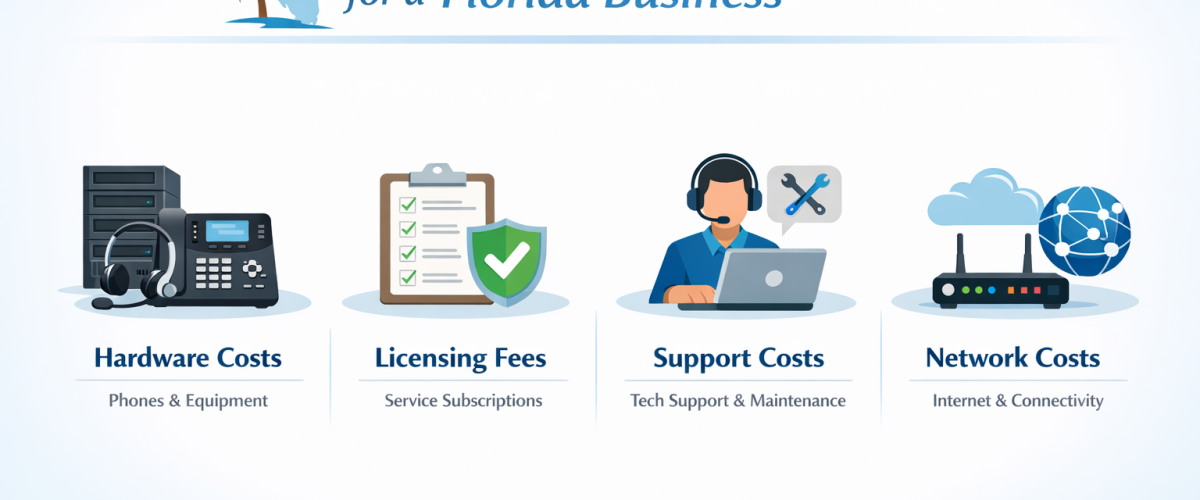
- Total cost of ownership includes hardware, licensing, support, and network costs.
- Hidden fees such as porting charges and overage rates can add 15 to 25 percent to annual spend.
- Florida businesses should evaluate at least three providers before committing.
- A 36-month TCO model gives the most accurate cost comparison.
- Network readiness directly affects VoIP call quality and may require upfront investment.
Methodology
This guide draws on publicly available pricing data from major VoIP providers, FCC telecommunications reporting, and industry research from recognized analyst sources. Cost ranges reflect typical Florida market conditions as of early 2026. Individual quotes will vary based on seat count, contract length, and feature requirements.
What is VoIP and How Does it Work?
Voice over Internet Protocol, or VoIP, converts voice signals into digital data packets and transmits them over a broadband internet connection. Unlike traditional public switched telephone networks, VoIP does not require dedicated copper lines. Calls are routed through cloud servers managed by a VoIP provider, which means businesses pay for a software service rather than physical infrastructure.
For Florida businesses, this model is particularly relevant because the state has a high concentration of small businesses, remote workers, and multi-location operations that benefit from unified cloud communication. According to the FCC’s VoIP consumer guide, VoIP services are subject to specific regulatory requirements that businesses should review before deployment.
Understanding Total Cost of Ownership
Total cost of ownership, or TCO, is the complete financial picture of a technology investment over a defined period. For VoIP, TCO includes every dollar spent from initial setup through ongoing operation. Finance teams in Florida should model TCO across at least 24 to 36 months to make a valid comparison against existing phone systems.
A standard VoIP TCO model includes five categories: hardware acquisition, software licensing, implementation and training, ongoing support, and network infrastructure. Skipping any category produces an incomplete number that leads to budget overruns.
Breakdown of VoIP Costs for Florida Businesses
Prices verified March 2026. Pricing may vary by promotions, billing cycle, and add-on features.
| Cost Category | Typical Range | Notes |
|---|---|---|
| Per-seat monthly license | $20 to $45 per user | Varies by feature tier |
| IP desk phones | $80 to $250 per unit | One-time hardware cost |
| Installation and setup | $500 to $3,000 | Depends on seat count |
| Network upgrades | $0 to $5,000 | Required if bandwidth is insufficient |
| Annual support contract | $10 to $20 per user per month | Optional but recommended |
For a Florida business with 20 employees, a realistic 36-month TCO lands between $22,000 and $38,000 depending on provider, hardware choices, and support level. This compares favorably to legacy PBX systems, which often carry higher maintenance and line rental costs. NIST’s communications technology research supports the shift toward software-defined communication for cost efficiency.
Hidden Costs in VoIP Services
Hidden costs are the most common source of budget overruns in VoIP deployments. Florida businesses should request itemized quotes and ask providers directly about each of the following:
- Number porting fees: Moving existing phone numbers to a new provider typically costs $20 to $50 per number.
- International calling rates: Standard plans often exclude international minutes, which are billed separately.
- Overage charges: Unlimited plans may cap usage or throttle quality after a threshold.
- Contract termination fees: Early exit penalties can reach several months of remaining contract value.
- Feature add-ons: Call recording, advanced analytics, and CRM integrations are frequently sold as paid upgrades.
Comparing VoIP Providers in Florida
Florida businesses have access to national providers as well as regional carriers with local support teams. When comparing providers, evaluate total contract value rather than advertised per-seat price. Key comparison criteria include uptime SLA guarantees, data center redundancy, E911 compliance, and customer support response times.
Review provider documentation carefully. For example, Google Search Central’s content quality guidelines offer a useful parallel: just as content quality signals matter for search visibility, provider reliability signals matter for communication uptime. Businesses should request references from Florida clients of similar size before committing.
Maximizing ROI on VoIP Solutions
Return on investment from VoIP improves when businesses consolidate communication tools. Replacing separate conferencing, fax, and messaging subscriptions with a unified VoIP platform reduces total spend. Florida businesses with remote or hybrid teams gain additional ROI through mobile app access, which eliminates the need for separate mobile plans for business calls.
Internal process improvements also contribute to ROI. Auto-attendant features reduce receptionist workload. Call analytics help managers identify training needs. Integration with CRM platforms shortens sales call documentation time. According to Gartner’s unified communications research, businesses that fully integrate VoIP with existing workflows report higher satisfaction and faster payback periods.
Case Study: Regional Florida Service Business
A Florida-based property management company with 18 employees switched from a legacy PBX system to a cloud VoIP platform in mid-2024. Their previous annual phone spend was approximately $28,000 including line rental, maintenance, and long-distance charges. After switching, their 12-month VoIP spend including hardware, licensing, and support totaled $14,400. The company also eliminated a separate conferencing subscription worth $1,800 per year. Total first-year savings reached approximately $15,400, representing a 55 percent reduction in communication costs. Call quality complaints dropped by 40 percent based on internal support ticket data.
Common Mistakes Florida Businesses Make
- Evaluating only the per-seat price: Advertised rates rarely reflect total cost. Always model full TCO.
- Skipping network assessment: Insufficient bandwidth causes call quality problems that erode productivity gains.
- Ignoring E911 requirements: Florida businesses must ensure VoIP providers meet state and federal E911 compliance standards.
- Choosing the wrong feature tier: Overpaying for unused features or underpaying and missing critical tools both reduce ROI.
- Not negotiating contract terms: Many providers offer flexibility on termination clauses and price locks that buyers do not request.
Practical Steps to Evaluate VoIP Costs
- Audit your current monthly communication spend including all line items.
- Count active users and identify peak concurrent call volume.
- Test your internet connection speed and quality using a bandwidth assessment tool.
- Request itemized quotes from at least three Florida VoIP providers.
- Build a 36-month TCO spreadsheet comparing each quote against your current spend.
- Verify E911 compliance and uptime SLA terms in each contract.
- Negotiate contract length, termination terms, and price lock provisions.
Download the keyword clustering template to organize your VoIP vendor evaluation and cost comparison data in a structured format.
Frequently Asked Questions
What is a realistic monthly VoIP cost for a 10-person Florida business?
A 10-person Florida business can expect to pay between $200 and $450 per month for licensing alone, depending on the feature tier selected. Hardware and setup are additional one-time costs.
Does VoIP work reliably in Florida during hurricane season?
Cloud VoIP systems with geographically redundant data centers maintain service during local outages better than on-premise PBX systems. Businesses should confirm provider redundancy and failover policies before signing.
Are VoIP calls subject to Florida state taxes?
VoIP services may be subject to state and local taxes depending on service classification. Businesses should consult a tax advisor and review FCC regulatory guidance for current requirements.
How long does VoIP implementation take for a small Florida business?
Most small business VoIP deployments complete within one to three weeks, including number porting, hardware delivery, and staff training.
Update Log
- March 2026: Pricing table updated to reflect current provider rates. E911 compliance section expanded. Case study figures reviewed for accuracy.
About the Author
Author: Marcus Ellery
Bio: Marcus Ellery is an SEO strategist and technical content analyst with more than 10 years of experience evaluating search visibility, content systems, and business software.