
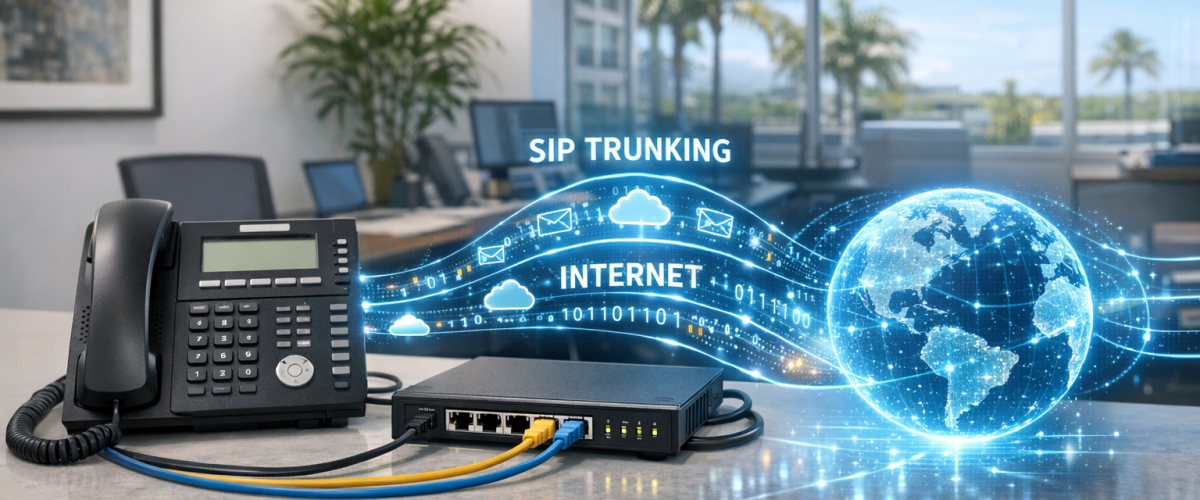
Enhance Your Legacy PBX with SIP Trunking
SIP trunking legacy PBX Florida solutions give businesses a practical way to extend the life of existing phone equipment without a full system replacement. Many Florida offices rely on PBX hardware that still performs reliably but lacks modern connectivity. SIP trunking bridges that gap by replacing traditional phone lines with internet-based voice channels. This guide explains how it works, what it costs, and how to implement it.
SIP trunking connects a legacy PBX system to the public telephone network over an internet connection using Session Initiation Protocol. For Florida businesses, this means keeping existing handsets and internal wiring while gaining lower call costs, scalability, and access to features like disaster recovery routing. No full hardware replacement is required in most cases.
Last Updated: September 2026
- Understanding SIP Trunking
- Benefits of SIP Trunking for Legacy PBX
- How SIP Trunking Works
- Cost Considerations
- Common Mistakes to Avoid
- Steps to Implement SIP Trunking
- Downloadable Resource
- Frequently Asked Questions
Understanding SIP Trunking
Session Initiation Protocol, or SIP, is the signaling standard that manages voice calls over IP networks. A SIP trunk is a virtual phone line delivered over a broadband connection. Unlike traditional PSTN lines that require physical copper pairs, SIP trunks are provisioned through a service provider and can be scaled up or down quickly.
For Florida businesses using legacy PBX hardware, a SIP-compatible gateway or adapter connects the existing system to a SIP trunk provider. This preserves the internal PBX infrastructure while modernizing the external connection. The ITU maintains international standards for multimedia communication protocols that underpin SIP technology.
Benefits of SIP Trunking for Legacy PBX
The primary SIP trunking benefits for legacy PBX users include cost reduction, flexibility, and business continuity. Key advantages include:
- Lower line costs: SIP trunks typically cost less per channel than traditional ISDN or analog lines.
- Scalability: Add or remove channels without waiting for a technician to install physical lines.
- Geographic flexibility: Florida businesses with multiple locations can consolidate trunking at one point.
- Disaster recovery: Calls can be rerouted to mobile numbers or alternate sites if the primary office is unavailable.
- Number portability: Existing business numbers transfer to the SIP provider in most cases.
The FCC provides consumer guidance on VoIP technology and regulatory considerations relevant to businesses making this transition.
How SIP Trunking Works
When a call is placed from a legacy PBX connected via SIP trunking, the PBX sends the call signal to a gateway device. The gateway converts the signal into SIP packets and transmits them over the internet to the SIP trunk provider. The provider routes the call to its destination through the public telephone network or directly over IP if the receiving party supports it.
Quality of Service settings on the business router prioritize voice traffic to reduce latency and packet loss. Most SIP trunk providers recommend a dedicated internet connection or at minimum a router with QoS capabilities. NIST Special Publication 800-58 covers security considerations for VoIP systems, which is relevant when deploying SIP trunks in business environments.
Cost Considerations
SIP trunking pricing typically follows one of two models: metered or unlimited. Metered plans charge per minute and suit businesses with lower call volumes. Unlimited plans charge a flat monthly fee per channel and work well for high-volume offices.
Prices verified March 2026. Pricing may vary by promotions, billing cycle, and add-on features.
A typical SIP trunk channel in the United States ranges from $15 to $30 per month depending on the provider and included features. A gateway device for connecting a legacy PBX costs between $150 and $600 as a one-time hardware expense. Businesses replacing 10 analog lines can often reduce monthly telecom costs by 30 to 50 percent after the transition.
Common Mistakes to Avoid
Florida businesses transitioning to SIP trunking frequently encounter avoidable problems. The most common include:
- Skipping a network assessment: Insufficient bandwidth or poor QoS configuration causes call quality issues.
- Choosing an incompatible gateway: Not all gateways work with every PBX model. Verify compatibility before purchasing.
- Ignoring E911 requirements: SIP trunking providers must support Enhanced 911. Confirm compliance before going live.
- Underestimating channel needs: Too few SIP channels cause busy signals during peak hours. Calculate concurrent call requirements carefully.
- Missing a failover plan: Without a backup routing rule, an internet outage takes down all phone lines.
Steps to Implement SIP Trunking
- Audit your current PBX: Identify the make, model, and available interface types such as FXO, BRI, or PRI ports.
- Assess your internet connection: Confirm available bandwidth and whether your router supports QoS configuration.
- Select a SIP trunk provider: Compare pricing, E911 support, contract terms, and customer service availability in Florida.
- Purchase a compatible gateway: Match the gateway to your PBX interface type and the provider’s SIP specifications.
- Configure QoS on your router: Prioritize SIP and RTP traffic to protect call quality.
- Port your existing numbers: Submit a Letter of Authorization to your new provider to transfer business numbers.
- Test before cutover: Run parallel testing with a small number of lines before fully decommissioning legacy lines.
- Train staff and document the setup: Ensure your team understands any changes to call handling procedures.
Google Search Central offers guidance on building trustworthy, well-structured content for businesses publishing technical resources online.
Downloadable Resource
Use the template below to organize your SIP trunking evaluation, including channel calculations, provider comparison fields, and a pre-cutover checklist.
Download the keyword clustering template
Frequently Asked Questions
Can any legacy PBX work with SIP trunking?
Most legacy PBX systems can connect to SIP trunking using a compatible analog or digital gateway. Systems with native SIP support may connect directly. Always verify compatibility with your PBX manufacturer before selecting a gateway.
Is SIP trunking reliable enough for business use in Florida?
Yes, when deployed with adequate bandwidth and QoS settings. Many Florida businesses also configure failover routing to mobile numbers to maintain service during internet outages or severe weather events.
How many SIP channels does a typical small business need?
A common rule is one channel per three to five employees for businesses with moderate call volume. Analyze your current concurrent call data from your existing phone bill to get a more accurate estimate.
What happens to my existing phone numbers?
In most cases, existing business numbers can be ported to your SIP trunk provider. The porting process typically takes 5 to 15 business days depending on the losing carrier.