

Florida VoIP Contract Renewal Checklist
Your current VoIP contract is ending—or it already auto-renewed while you were busy running your business. Before you sign another year with a provider that has been dropping calls, burying fees, or leaving you on hold with a national support queue, work through this checklist. It covers the renewal red flags Florida businesses miss, how to renegotiate from a position of knowledge, and the clearest signs that switching providers is the smarter move.
Who This Checklist Is For
This guide is for you if:
- You manage or own a Florida business with 5 or more employees who use business phones daily.
- Your current VoIP or landline contract is within 90 days of renewal—or has already auto-renewed.
- You are paying for features you do not use, or missing features you actually need (call queues, auto-attendant, voicemail to email, mobile softphones).
- Your support calls go to a national call center and the problem still is not fixed a week later.
- You operate multiple Florida locations and your phone system does not handle call handoffs cleanly.
- You are in a healthcare-adjacent office and need call flows configured to support applicable HIPAA obligations.
This guide is NOT for you if:
- You are a solo operator with one line and no staff—a consumer VoIP app may be all you need.
- You are under a long-term contract with steep early-termination fees and have not yet calculated whether switching still saves money over the remaining term.
- Your current provider is performing well, billing transparently, and answering support calls promptly—in that case, renegotiating pricing is still worth a read, but switching is not urgent.
Quick Provider Comparison
Before diving into the checklist, here is an honest side-by-side of the options Florida businesses typically consider at renewal time.
| Provider / Option | Pricing Model | Contract | Local Florida Support | Number Porting | Best For |
|---|---|---|---|---|---|
| Mynians VoIP | From $22.95/licensed user/mo (5-user min) | Month-to-month, 30-day notice | Yes — Orlando-area local techs | Handled end-to-end | Florida SMBs wanting local support and transparent billing |
| RingCentral | Per-user, tiered; pricing varies | Annual or multi-year typical | No — national call center | Self-managed or assisted | Large enterprises with dedicated IT staff |
| Nextiva | Per-user, tiered; pricing varies | Annual typical | No — national call center | Self-managed or assisted | Businesses prioritizing CRM integrations |
| AT&T Business | Bundled; line-based pricing common | 1–3 year contracts common | Regional, not local | Carrier-managed, can be slow | Businesses already in AT&T ecosystem |
| Legacy PBX / Landline | Hardware + line rental; high maintenance | Varies; hardware depreciation | Depends on local vendor | Complex, often requires vendor | Businesses not yet ready to move to cloud |
| DIY Softphone Apps | Low or free per seat | None | None | Limited or none | Solo operators or very small teams only |
Pricing for third-party providers is subject to change. Verify current rates directly with each vendor before making a decision.
Renewal Red Flags to Catch Before You Sign
Work through this checklist in the 90 days before your contract end date. If you check three or more of these boxes, you have a strong case for either renegotiating or switching.
Billing and Pricing Red Flags
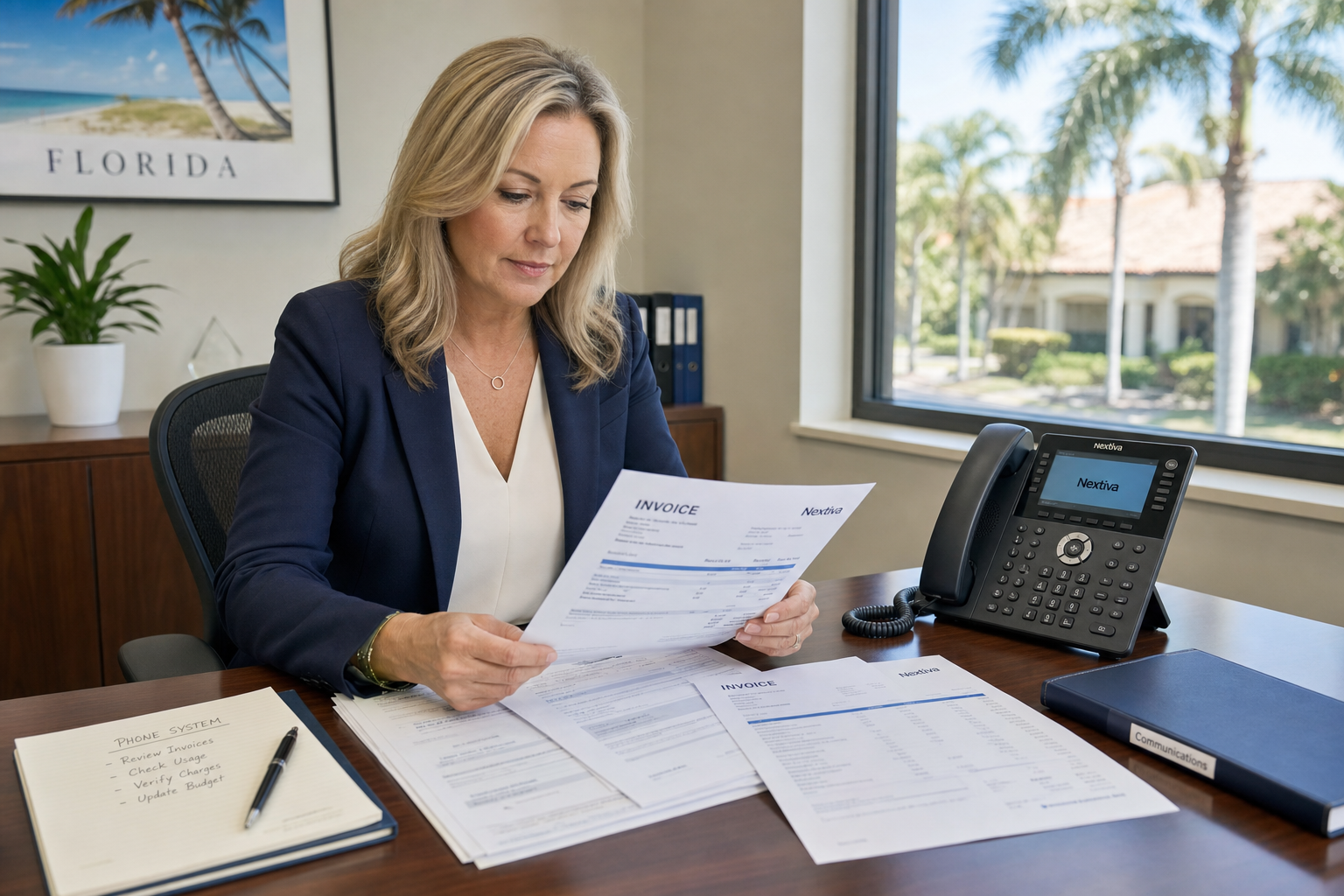
- Your monthly bill has increased without a service upgrade. Pull invoices from the past 12 months and compare line by line. Regulatory recovery fees, administrative fees, and “network access” charges can quietly inflate a bill by 20–30% over a contract term.
- You are paying for more licensed users than you have staff. If your team shrank or turned over and you never adjusted your seat count, you are overpaying every month.
- The renewal quote is higher than your current rate with no explanation. Providers often raise rates at renewal assuming you will not shop around. You should.
- You cannot get an itemized bill that breaks down every charge. If your provider cannot explain every line item, that is a problem.
Service and Support Red Flags
- Support tickets take more than 24 hours to get a real response. For a business phone system, that is too slow. Dropped calls and routing failures cost you customers in real time.
- You have never spoken to the same support person twice. National providers rotate agents. Local providers know your setup.
- Call quality complaints from staff or customers have gone unresolved. Jitter, echo, and dropped calls are not normal. They are symptoms of a misconfigured or undersized system.
- Your auto-attendant or call routing has not been updated since installation. Business hours change. Staff changes. If your phone system has not kept up, callers are hitting dead ends.
Florida-Specific Risk Flags
- No failover or redundancy plan for hurricane season. Florida businesses need a documented plan for what happens to inbound calls when power or internet goes down. If your provider has not discussed this with you, ask—or find one who will.
- Your multi-location call handoffs are broken or manual. If transferring a call between your Orlando office and your Tampa location requires a workaround, your system is not configured correctly.
- You have no mobile or desktop softphone option for remote staff. Florida’s workforce is increasingly hybrid. A phone system that only works at a desk is a liability.
How to Decide: Renegotiate or Switch
When renegotiating makes sense
Renegotiating is worth pursuing if your provider’s core service is solid but the pricing has drifted or your feature set needs updating. Go into the conversation with competing quotes in hand—providers are more flexible when they know you have done your homework. Ask specifically for:
- A rate match or reduction based on your current licensed user count
- Removal of fees that were not in your original agreement
- A shorter contract term or a month-to-month option
- Added features (voicemail to email, mobile softphone, call recording) at no additional cost
When switching is the right call
Switch providers when the problems are structural, not just pricing. If support is consistently slow, call quality is unreliable, your system has no failover plan, or your provider cannot handle multi-location routing without a workaround, a lower renewal rate does not fix any of that. You will be paying less for the same broken experience.
The practical switching checklist:
- Confirm your contract end date and cancellation notice window (typically 30–60 days written notice).
- Audit your licensed user count and the features you actually use.
- Get itemized quotes from at least two providers before your notice window closes.
- Confirm the new provider handles number porting end-to-end—you should not have to manage that process yourself.
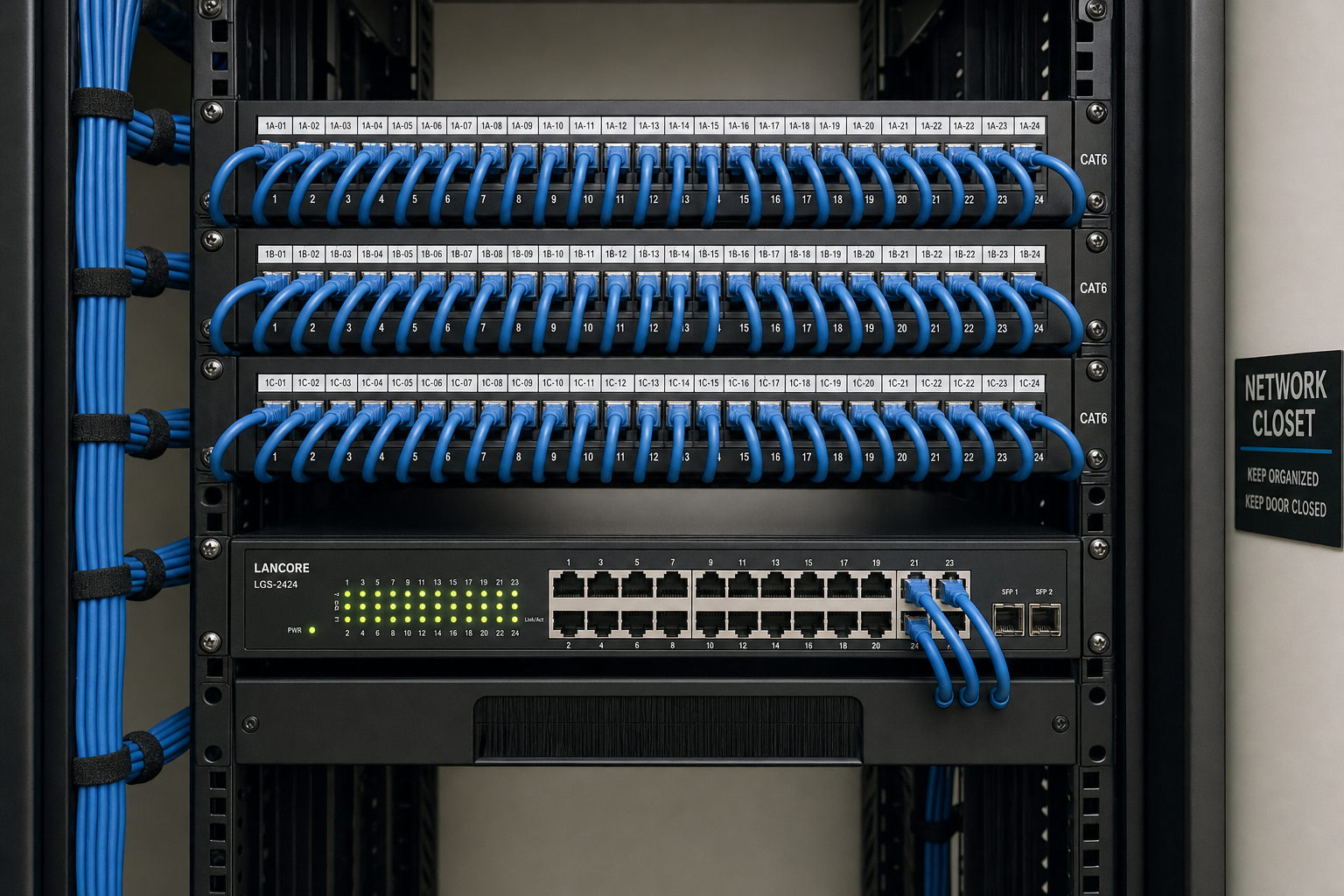
- Verify network readiness at your location before committing to an installation timeline. A good provider will review this with you before quoting.
- Confirm what hardware you own versus what is leased, and whether it is compatible with the new system.
What Happens During the Switch: Porting and Installation
Two things stop Florida businesses from switching providers even when they know they should: fear of losing their phone numbers and uncertainty about how long the cutover will take. Here is what actually happens.
Number porting
Your existing business phone numbers are portable. The FCC requires carriers to release numbers when a customer requests a port to a new provider. The process involves submitting a Letter of Authorization (LOA) and account information to the new carrier, who coordinates the transfer with your current provider. Porting timelines vary depending on the number type, your current carrier’s responsiveness, and whether the account information matches exactly. Mynians VoIP handles number porting end-to-end—you provide the account details and we manage the coordination.
Common porting mistakes to avoid:
- Canceling your current service before the port completes—this can strand your numbers
- Submitting account information that does not exactly match your carrier’s records
- Porting toll-free numbers without confirming the new provider supports them
Installation and cutover
Installation timelines are confirmed per site after reviewing network readiness, existing hardware, and porting status. There is no universal timeline that applies to every Florida business—a 6-person single-location office and a 40-person multi-site operation have different requirements. What you should expect from any reputable provider is a site review before a timeline is committed, not a generic promise.
Mynians VoIP’s standard implementation fee is $149 for 5–9 licensed users. For 10 or more licensed users, implementation is included. Hardware, taxes, fees, and any quoted add-ons are separate.
Why Local Support Changes the Equation in Florida
Florida businesses deal with problems that national VoIP providers are not built to handle at the local level: hurricane-season outages, regional internet infrastructure issues, and the reality that when something breaks at 8 a.m. on a Monday, you need someone who can actually show up or who already knows your setup.
Mynians VoIP is the Florida business phone division of Mynians, a Winter Garden, Florida technology company with over two decades of hands-on experience. The team serves businesses across Orlando, Winter Garden, Tampa, Miami, and Jacksonville. When you call (407) 374-2782, you reach real techs—not a national support queue routing you to whoever is available in a different time zone.
Local support matters specifically for:
- Failover and redundancy configuration. Florida’s hurricane season is not hypothetical. A local provider who understands your building’s infrastructure and your internet provider’s reliability can configure a failover plan that actually works for your location.
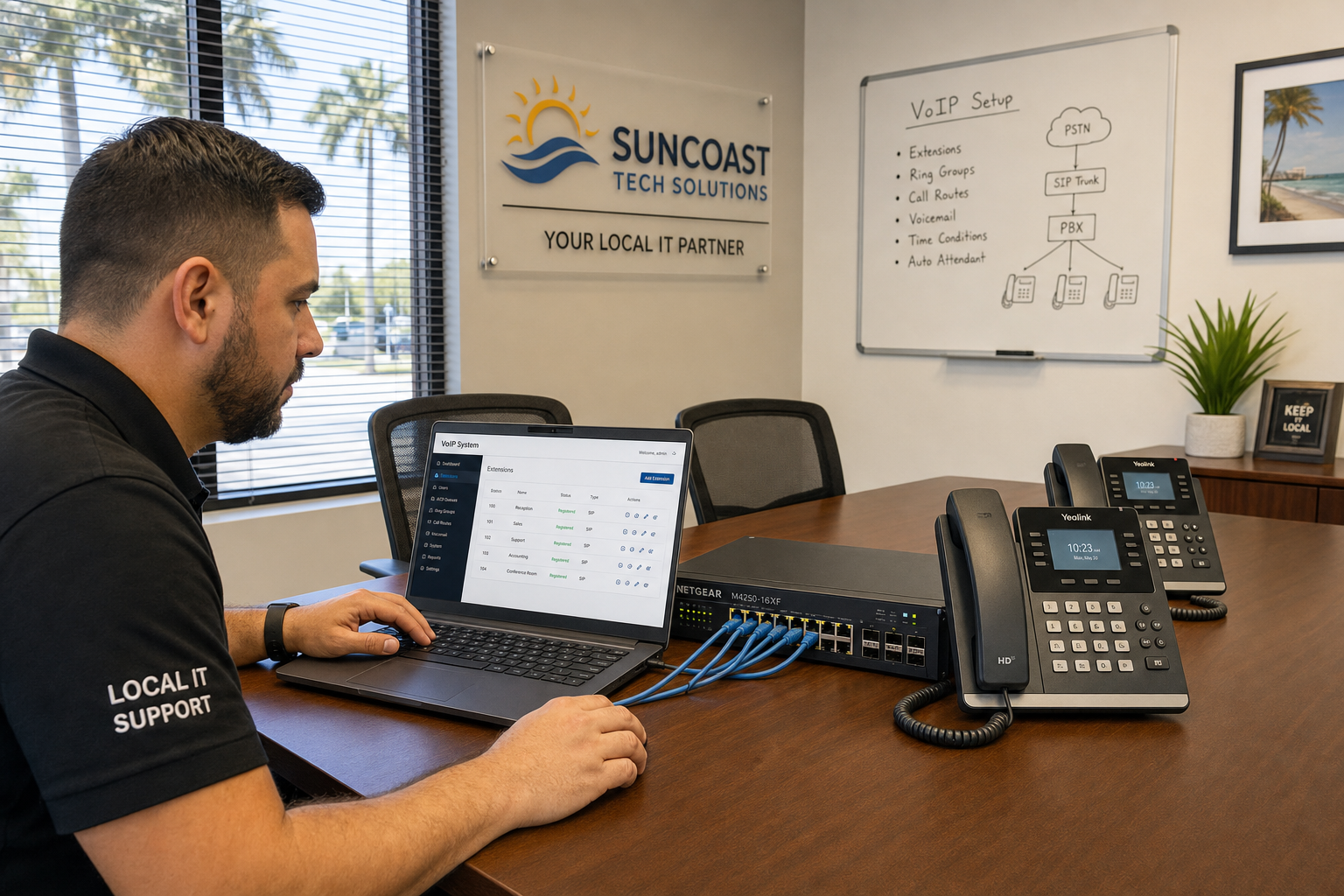
- On-site troubleshooting. Some problems cannot be fixed remotely. Structured cabling issues, hardware failures, and network closet problems require someone physically present. Mynians also provides managed IT and structured cabling through the wider company.
- After-hours routing gaps. If your front desk closes at 5 p.m. and calls are still ringing to an empty desk, that is a configuration problem a local team can fix in a single call.
- Multi-location call handoffs. Businesses with offices in multiple Florida cities need call routing that works across locations without manual workarounds. This requires someone who understands your full setup, not just one site.
For businesses with healthcare-adjacent workflows, Mynians VoIP can configure call flows to support applicable HIPAA obligations. This is a configuration service—verify your own compliance requirements with your compliance officer or legal counsel.
Is Mynians VoIP the Right Fit?
Mynians VoIP offers three published plan tiers, all priced per licensed user per month:
- Essential: $22.95 per licensed user per month, 5-user minimum
- Professional: $29.95 per licensed user per month, 5-user minimum
- Enterprise: Starting at $39.95 per licensed user per month, 10-user minimum, final quote required
Service is month-to-month with 30-day cancellation notice. There are no multi-year lock-ins. Full pricing details are available at voip.mynians.com/pricing.
Features include hosted business VoIP, cloud PBX, call routing and queues, auto-attendants, number porting handled end-to-end, mobile and desktop softphones, voicemail to email, multi-location systems, and failover and redundancy configuration.
The primary next step is an itemized written quote after reviewing your business’s phone needs. That starts with a free consultation—no pressure, no generic pitch. You bring your current bill and user count; the team reviews what you actually need and what it will cost.
Frequently Asked Questions
How far in advance should I start reviewing my VoIP contract before renewal?
Start at least 90 days before your contract end date. Most providers require 30–60 days written notice to cancel or opt out of auto-renewal. Starting at 90 days gives you time to audit your bill, get competing quotes, and make a decision without being rushed into signing again by default.
Can I keep my existing business phone numbers if I switch VoIP providers?
Yes. The FCC requires carriers to release your numbers when you request a port to a new provider. The process involves submitting a Letter of Authorization and matching account information. Do not cancel your current service before the port completes, or you risk losing your numbers. Mynians VoIP handles number porting end-to-end for Florida businesses.
What is the difference between a phone line and a licensed user in VoIP pricing?
A licensed user is the person using the VoIP system—an employee with an extension, a softphone, or a desk phone assigned to them. A phone line in legacy systems referred to a physical circuit. Modern hosted VoIP is priced per licensed user, not per line. Confusing the two can lead to overpaying if a provider quotes you lines instead of users, or underpaying and running into capacity issues.
How long does it take to switch VoIP providers in Florida?
Installation and porting timelines are confirmed per site after reviewing network readiness, existing hardware, and porting status. There is no single timeline that applies to every business. A provider who gives you a firm date before reviewing your site is guessing. Mynians VoIP reviews your network and hardware before committing to a timeline.
What does Mynians VoIP cost per month?
Mynians VoIP plans start at $22.95 per licensed user per month for the Essential plan with a 5-user minimum. The Professional plan is $29.95 per licensed user per month with a 5-user minimum. Enterprise starts at $39.95 per licensed user per month with a 10-user minimum and requires a final quote. Standard implementation is $149 for 5–9 licensed users and is included for 10 or more. Hardware, taxes, fees, and quoted add-ons are separate. Service is month-to-month with 30-day cancellation notice.
Why does local VoIP support matter for Florida businesses?
Florida businesses face specific challenges that national providers are not positioned to handle at the local level: hurricane-season outages, regional internet infrastructure issues, and the need for someone who can physically show up when remote troubleshooting is not enough. Mynians VoIP is based in Winter Garden, Florida, and serves businesses across Orlando, Tampa, Miami, and Jacksonville with real local techs—not a national call center queue.
Update Log
- October 2026: Created and reviewed for Mynians VoIP business phone system accuracy.