

How to Choose a VoIP Provider in Florida
Picking the wrong VoIP provider costs Florida businesses more than money. It costs time, productivity, and customer trust. Weeks-long installs, confusing carrier bills, dropped calls during hurricane season, and a national call center that puts you on hold — these are real problems that real Florida businesses deal with every year. This guide gives you a practical, no-fluff checklist to evaluate any VoIP vendor before you sign anything.
Provider Comparison at a Glance
Before diving into the checklist, here is an honest side-by-side look at the types of VoIP options Florida businesses typically evaluate. Use this as a starting framework, not a final decision.
| Provider Type | Install Speed | Local Support | Contract | Porting Handled | Failover Config | Starting Price |
|---|---|---|---|---|---|---|
| Mynians VoIP (Orlando-based) | 72 hours (site-ready) | Yes — local FL team | Month-to-month | End-to-end included | Yes — configured | $17.95/line/mo |
| RingCentral | Days to weeks | National call center | Annual typical | Self-managed or assisted | Available, DIY setup | Varies by plan |
| Nextiva | Days to weeks | National call center | Annual typical | Assisted | Available, DIY setup | Varies by plan |
| AT&T Business | Weeks to months | Regional dispatch | Multi-year common | Carrier-managed | Limited options | Higher per line |
| Legacy PBX / Landline | Weeks+ | Varies by vendor | Hardware lease common | Complex | Minimal | High hardware cost |
| DIY Softphone Apps | Immediate | None | None | Self-managed | None | Low upfront, high risk |
The table above reflects general market positioning. Exact pricing and terms for national providers change frequently — always request a current quote directly from each vendor.
Who This Guide Is For
This guide is for you if:
- You run a Florida business with 5 or more phone lines and your current system is unreliable, overpriced, or both.
- You are an operations manager evaluating vendors and need a structured way to compare them.
- You have been burned by a national provider’s install delays, surprise fees, or unresponsive support.
- You are opening a new Florida office and need phones up fast without a long-term commitment.
- You operate multiple locations across Florida — Orlando, Tampa, Miami, Jacksonville — and need consistent call routing across all of them.
- You work in healthcare and need HIPAA-compliant call flows handled correctly from day one.
This guide is NOT for you if:
- You are a solo freelancer who just needs a personal cell phone plan.
- You are looking for a consumer VoIP app for home use.
- You have fewer than 5 lines and no plans to grow.
The Florida VoIP Provider Checklist
Run every vendor you evaluate through this checklist. If they cannot answer these questions clearly, that is your answer.
1. Uptime SLA — Get It in Writing
Ask for the published uptime SLA, not a sales rep’s verbal assurance. A credible provider publishes this. Mynians VoIP publishes a 99.99% uptime SLA. If a vendor cannot point you to a published document, move on.
2. Install Timeline — Confirm the Conditions
A 72-hour install is real — but only when the site is network-ready. Ask the vendor: Who verifies network readiness before the install date? Do they check your cabling, switches, and internet bandwidth ahead of time, or do they show up and discover problems on day one? A provider with in-house cabling and network capabilities can catch and fix those issues before they delay your go-live date.
3. Number Porting — Who Owns the Process
Porting your existing business numbers is where most switchovers go wrong. Delays, dropped numbers, and days without an active line are common when porting is left to the customer. Ask: Does the provider handle porting end-to-end, or do they hand you a form and wish you luck? End-to-end porting management is a non-negotiable for any business that cannot afford to lose its main number.
4. Failover and Redundancy — Florida-Specific Risk
Florida businesses face a risk that providers in other states rarely plan for: hurricane-season outages. Ask every vendor how calls are routed when your primary internet connection goes down. Is failover configured automatically, or is it something you have to set up yourself after a problem occurs? A properly configured failover routes calls to mobile numbers, a secondary location, or a cloud queue — automatically, without manual intervention.
5. Call Quality — Ask About QoS and Bandwidth
VoIP call quality depends on your network as much as the provider’s infrastructure. Ask whether the provider assesses your current bandwidth and Quality of Service (QoS) settings before install. The FCC provides public guidance on broadband performance standards that can help you benchmark your connection before any VoIP deployment.
6. Support Responsiveness — Local vs. National Call Center
When a call queue goes down at 9 a.m. on a Tuesday, you need a real tech, not a ticket number. Ask: Who answers support calls? Is it a local team or a national call center? How long is the average response time? Can they dispatch on-site if needed?
7. Pricing Transparency — Per-Line, No Surprises
Ask for a line-by-line quote. Vague bundle pricing almost always hides fees. Look for per-line pricing that is published, not negotiated after a sales call. Ask whether the quote includes taxes, porting fees, hardware, and setup costs — or whether those are added later.
8. Contract Terms — Month-to-Month vs. Annual Lock-In
A provider confident in their service does not need a multi-year contract to keep your business. Month-to-month terms protect you if performance does not match the sales pitch.
Install Speed: What 72 Hours Actually Means
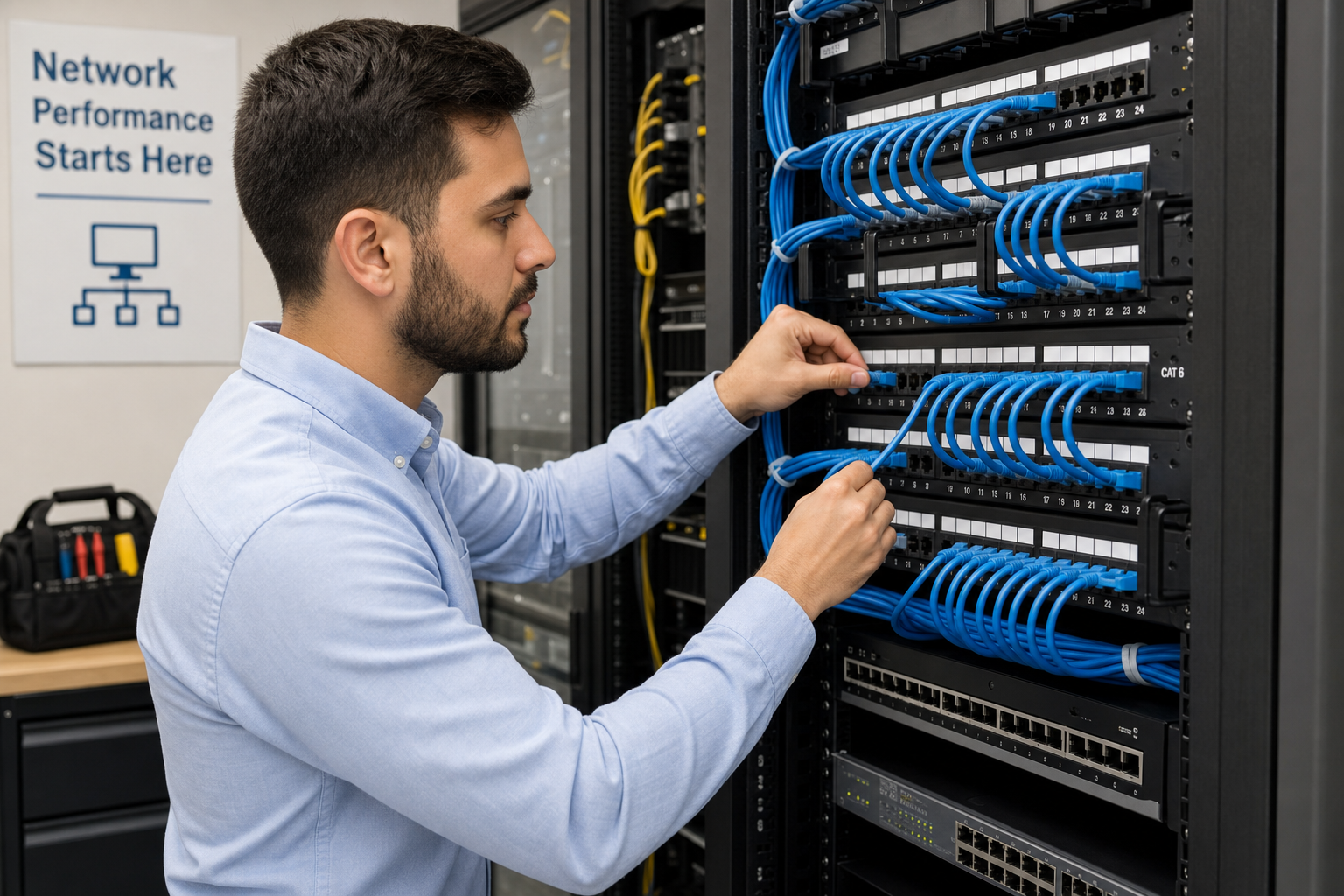
A 72-hour install is not magic — it is preparation. The clock starts when the site is confirmed ready: active internet connection with adequate bandwidth, a properly configured network switch, and physical cabling that meets voice traffic standards. When those conditions are met, a local team can provision cloud PBX settings, configure auto-attendants and call routing, deploy desk phones or softphone apps, and have your team making and receiving calls within three business days.
Where installs drag on for weeks with national providers, it is usually because no one verified site readiness before the scheduled date. A provider with in-house structured cabling and network capabilities — like the wider Mynians team — can handle that pre-work as part of the same engagement, so the install date holds.
Failover and Hurricane-Season Reliability
Florida businesses operate in one of the most weather-exposed markets in the country. A VoIP system without a tested failover plan is a liability, not an asset. Proper failover configuration means that when your primary internet circuit goes down — whether from a storm, a fiber cut, or a carrier outage — your calls do not just disappear. They route automatically to a mobile number, a secondary office, or a cloud-based call queue that keeps your front desk reachable.
Ask your vendor to walk you through exactly what happens to an inbound call during an outage. If the answer is vague, the failover is not configured. The Cybersecurity and Infrastructure Security Agency (CISA) publishes communications resilience guidance that outlines why redundancy planning matters for business continuity — worth reviewing before any phone system decision.
Number Porting: What Can Go Wrong
Number porting is the process of moving your existing business phone numbers from your current carrier to your new VoIP provider. Done correctly, it is invisible to your customers. Done poorly, it can leave your main business number unreachable for days.
Common porting problems include:
- Incorrect account information submitted to the losing carrier, causing the port to be rejected.
- Porting initiated too close to the go-live date, leaving a gap in service.
- The customer being responsible for managing the process with no guidance.
- Numbers ported without testing the new system first, so problems surface after the old service is already cancelled.
End-to-end porting management means the provider handles the paperwork, coordinates with the losing carrier, sets the port date, and confirms the number is live and routing correctly before the old service is released. That is the standard you should hold every vendor to.
Why Local Support Changes Everything
There is a real difference between a support team based in Orlando and a national call center routing tickets through three time zones. Local support means a tech who can be on-site the same day if needed. It means someone who has worked in Florida office buildings, knows the cabling challenges in older commercial spaces, and understands that your front desk cannot be down for four hours waiting on a callback.
For businesses evaluating business VoIP Florida options, the support model is often the deciding factor — not the feature list. Features are roughly comparable across hosted VoIP platforms. What is not comparable is whether a real tech answers the phone when something breaks.
Mynians VoIP is the Florida business phone division of Mynians, a Winter Garden, Florida technology company with over two decades of hands-on experience. The support team is local — not a national call center. That matters when you need answers, not a ticket number.
Understanding Per-Line Pricing
VoIP pricing should be straightforward. Per-line pricing means you pay a fixed monthly rate for each active line, and you know exactly what you are getting. Mynians VoIP publishes three tiers:
- Essential — $17.95/line/month (5-line minimum): Core hosted VoIP features for businesses that need reliable phones without complexity.
- Professional — $27.95/line/month: Expanded features for businesses with higher call volume or more advanced routing needs.
- Enterprise — $32.99/line/month (10-line minimum): Full-featured cloud PBX with advanced call flows, multi-location support, and priority configuration.
All plans are month-to-month with no long-term contracts. Number porting is included end-to-end. For a detailed breakdown, see the Mynians VoIP pricing page. Exact savings compared to your current bill are best confirmed on a free consultation call, where we review your current invoice line by line.
When comparing quotes from any provider, ask these questions before accepting a number:
- Is porting included or billed separately?
- Are taxes and regulatory fees included in the per-line rate?
- Is hardware included or leased separately?
- What happens to the price after the first year?
What Happens on a Free Consultation Call
A free VoIP consultation with Mynians is a working call, not a sales pitch. Here is what it covers:
- Bill review: You share your current phone bill. We identify what you are actually paying per line, including fees that are often buried in carrier invoices.
- Line-by-line quote: We build a quote based on your actual line count, locations, and feature needs — not a generic package.
- Site readiness check: We ask about your current internet connection, cabling, and network setup to flag anything that could affect install speed or call quality.
- Porting timeline: If you have existing numbers, we walk through what the port process looks like for your specific carrier.
- Questions answered: You leave with real answers, not a follow-up email that never comes.
To book a call, visit the consultation page or call (407) 374-2782.
Frequently Asked Questions
How long does a VoIP installation take for a Florida business?
When the site is network-ready — meaning adequate internet bandwidth, a properly configured switch, and working cabling — Mynians VoIP can complete installations across major Florida markets in 72 hours. If the site needs cabling or network work first, that is handled as part of the same engagement so the go-live date stays on track.
What can go wrong during number porting?
The most common porting problems are incorrect account information submitted to the losing carrier, porting initiated too close to the go-live date, and customers being left to manage the process themselves. End-to-end porting management — where the provider handles all coordination with the losing carrier — eliminates most of these risks. Mynians VoIP handles porting end-to-end and includes it in the service.
What is the starting price for Mynians VoIP?
Mynians VoIP Essential plans start at $17.95 per line per month with a 5-line minimum. Professional plans are $27.95 per line per month, and Enterprise plans are $32.99 per line per month with a 10-line minimum. All plans are month-to-month with no long-term contracts. Exact savings compared to your current bill are confirmed during a free consultation.
How does VoIP handle outages during hurricane season in Florida?
A properly configured VoIP system includes failover routing that automatically redirects inbound calls to mobile numbers, a secondary location, or a cloud call queue when the primary internet connection goes down. This configuration must be set up in advance — it does not happen automatically unless your provider has built it into your system. Ask any vendor to walk you through exactly what happens to a call during an outage before you commit.
Why does local VoIP support matter more than a national provider?
Local support means a real tech who can respond quickly, dispatch on-site if needed, and understands the specific network and cabling conditions common in Florida commercial buildings. A national call center routes your issue through a ticket queue with no on-site capability. When your phone system is down during business hours, the difference between local and national support is measured in hours of lost productivity.
Do I need a contract to use Mynians VoIP?
No. Mynians VoIP operates on month-to-month terms with no long-term contracts required. This means your service continues because it performs, not because you are locked in.
Update Log
- July 2026: Created and reviewed for Mynians VoIP business phone system accuracy.



Post a Comment